DEATH OF A WHALE: REQUIEM

Roddy along with his Father and sister return to Longstreet to see if Rhys and Jack will be able to succeed in towing the dead whale off the foreshore and back into the Channel thus saving their village from the threat of being engulfed in a stinking cloud from rotting whale.


As his elder sisters were not interested and his Mother liked to rest after Sunday lunch, only B and his Father were ready to accompany him back to Longstreet to see the attempt to tow the whale out to sea. The drive to Longstreet along the coast road in his Father’s car was such a contrast to the drive that morning with Rhys and his rattletrap van. His Father was a very experienced driver and always kept his car in excellent condition, so the drive was smooth and without drama. They parked in the Inn car park and Roddy led them across the road, past the Church and down the track that skirted the gardens of the cottages where Rhys and John lived. He pointed out Rhys’ cottage as they passed by, and then led them across the little bridge and up the top of the sea bank.


The day was still warm and sunny and very clear so that the view from the top of the sea bank was expansive. On the far side of the Channel they could see the hills plainly but the focus of their immediate interest was the whale, which lay in the foreground, unchanged since the morning and still with its attendant crowd of gulls. Roddy had bought his binoculars with him and was able to train them on to the whale. It was with a sad gasp that he saw that the birds had already pecked out the eyes of the whale. The rest of the giant sea mammal was not so easy for them and they had not made much of a dent in its thick black skin. The gulls and a few crows were perched on the back of the whale, pecking hopefully at it. Eventually one of the birds would make a hole in the skin and then it would be relatively easy to exploit that and feast on the soft flesh beneath. He looked across at his Father and B and noticed that the exotic sight had captivated them.


“That is huge. I had never realized how big a whale could be as I had only ever seen them in pictures or on television.” His Father’s voice was tinged with awe. B was just silent but Roddy could tell that she was enthralled with the sight before her.


“Can you imagine what I felt when I saw it this morning just after the tide had left it. It was much blacker and glossier then and of course the eyes were still intact and I could see that there was life in the beast still.”


B turned to him with a new respect. “Did you walk up to it then? Weren’t you afraid?”


“Perhaps a little, but although it was huge it was not moving and neither could it. It did cross my mind that it might flip its tail when I was nearby. When I walked up and stood next to its head and looked into that great dark, liquid eye, I knew that I was safe and all I felt was a great sorrow for the poor creature.”


He looked again at the whale, with its attendant gaggle of squawking and screaming birds, and felt another surge of regret that such a huge and magnificent creature should come to such a meaningless end as a carcass stuck in a bowl of slimy mud being attacked by crows and seagulls. Adding to the incongruity was the beautiful late afternoon that surrounded them. The sun was still high, though clearly in the descendant, and the daylight had already softened slightly producing a warm golden effulgence around them. The people who had gathered noisily to watch the spectacle of the whale being towed out to sea, and perhaps some amusing and entertaining mishaps as well, began to fall silent as the soft golden light settled on them. In front of them, the white line of breaking waves showed that the tide was rapidly advancing, but as there was little in the way of wind, the waves were not large and so the tide’s advance was almost a gentle whispering whoosh as if the soft light had subdued it too. Roddy was reminded of some pictures that he had seen in a book illustrating Biblical stories where the pictures showed clouds made luminous by the sun’s rays. He understood what the illustrator had in mind; the light representing the presence of God, and had always found it to be just a crude piece of trickery. Yet, as the evening developed he found that the light was having an effect on him, almost as if the world was paying reverence to the death of the great whale and indicating that such a marvelous creature could not leave this world without its passing being marked. Beyond the whale he could see the hills on the opposite shore of the Channel changing from a bright green to a blue-green colour under the changing light that enhanced the scene before them.


His reverie was broken by the throbbing sound of an engine and turning he saw that John and Rhys had already launched the boat and were making their slow way down the gout, which was already filling with the incoming tide. The boat was small and made to look even smaller by the great bulk of John sitting in the stern and cradling the tiller under his arm. Rhys had the line that was attached to the whale and was giving it several turns around the bow post. John’s boat was indeed small but very tidy. It was a clinker built boat and John had kept it very neat and clean with a fresh coat of white paint. It was completely open with just a box amidships, which must contain the inboard engine. Rhys was standing and trying to keep his balance while managing the towline. John controlled the engine speed from a handle that was set at the rear of the engine cover and he had to lean forward to make any change in speed. Roddy thought that this must be a very awkward arrangement but he seemed to manage it easily.


John and Rhys had launched the boat from a slipway located near where the gout spilled through the seabank and they were moving seaward, rising steeply then falling back quickly on the waves that were higher as the incoming tide concentrated its power in the narrow gout. Roddy wondered if they had launched too early, as the tide still seemed to have a long way to go before the full.


“I don’t see how they will shift that great lump with that tiny thing,” said Roddy’s Father. “That engine sounds rather rough too and it does not seem to have much power.”


Roddy rather agreed with him but then he also thought of how both Rhys and John had both sailed and fished these waters for many years and probably knew far more about it than landlubbers like he and his Dad.


The little boat kept moving steadily seaward and made no attempt to get close to the whale carcass. Roddy could not understand what they were doing and how, by setting this course, they would ever be able to float the whale off its muddy grave and out to the open sea. Still they kept moving slowly seaward and the line was now stretched out at right angles to the tiny craft. Then Rhys began to move toward the stern, taking the line with him until he reached where John was sitting and took several turns of the line around a small brass bollard on the side of the boat. During this operation, John put the engine into neutral and the boat began to drift landward again. Roddy suddenly realized why they did that. As the gout was lined with wooden stakes, they had to keep the line from snagging on them, so they had to keep it free of the stakes until they were more or less abreast of the whale before moving the line to the normal towing position.


The tide continued its advance and he now noticed that the whale was moving slightly and starting to roll in time with the waves. It would soon be floating and Jack, by keeping his boat in the gout, which ran as a deeper water channel out to sea, did not have to risk running aground on the mud while the whale, once afloat would be pulled slowly into the deeper water channel behind his boat. Also, by making use of the deeper water in the gout they would be able to pull the whale far out to sea before the tide began to ebb and so make sure that the tide did not wash it back into the shallow water again. They needed to pull the whale far enough out to sea so that it would be caught up in one of the Channel’s fierce tidal currents and swept far down Channel and hopefully eventually sink beneath its murky waters.


Jack’s boat continued to hold its position as he and Rhys looked across at the whale waiting for it to float. The carcass began to roll on the incoming waves and Rhys turned to Jack and said something. Jack adjusted the throttle on his boat and it began to move slowly and steadily seaward and the line tautened until there was a perceptible tug on the whale’s tail. The boat slowed suddenly and Roddy wondered if they had miscalculated and would not be able to shift the giant carcass. A second tug on the line caused it to snap taut and a thin spray of water sprang up from it as the rope strands tightened and squeezed out the water that had soaked into it. Then the whale’s carcass moved a little more and a cheer went up from the little crowd that was leaning forward so as to catch every bit of this unusual event. Several more tugs later and the sporadic jerks gave way to a steady movement as the whale suddenly began to slide over the incoming tide. Boat and whale slowly gathered speed and began to head steadily for the deeper waters of the Channel. It looked as if they were being very cautious so as not to break the towline or pull it off the whale’s tail. Several of the crowd had wondered aloud if the carcass of the dead whale would stay afloat. Some said it would sink but others pointed out that there was probably enough gas inside it to keep it buoyant.


Everyone watched anxiously to see which group was right. The huge whale carcass continued to float along even though it wallowed deeply in the waves that spilled over its back. A soft sigh of relief went up from the watching crowd who, being mostly from Longstreet, had no wish to have the rotten stench of a disintegrating whale envelop their village for the next several days or even weeks.


As Jack’s little boat and the black mass of the whale receded into the Channel, the little crowd of onlookers began to melt away into the golden light of the glorious early summer evening. Roddy still stood stock still, training his binoculars on that sad sight even as it retreated from him, and reflecting once again on the profound sorrow that he felt about the death of the only whale that he had ever encountered. The sight of the life spark fading from that great limpid black eye would stay in his consciousness forever. He wondered how far out into the Channel they would take the whale’s carcass before casting it adrift to the fates of tides and churning currents.


“Well, I’ll be blowed!” was the expostulation from his heretofore-silent Father. “I really never thought that they would be able to tow that great thing out with that little boat. I had visions of the boat tugging hard and failing to dislodge that big beast and their little engine breaking down under the strain. This deserves a little celebration. Let’s go and see Harry at The Bell and have a jar of ale. Or at least I shall have a jar and you children can have some pop and crisps. It’s a nice warm evening and you can sit out in front or in the garden while I chat with Harry. I haven’t seen the old bugger for a while.”


The walk from the sea bank to The Bell that evening was magical. The sound of the waves from the advancing tide wafted over the sea bank and was the background accompaniment to the joyous singing of blackbirds and thrushes who seemed inspired by the deepening golden light that was now filtering softly through the trees, casting smoky purple shadows on the meadows. Insects buzzed in the reed beds as if they were jolted into a frenzy of activity by the warm evening. There was no talk between Father and children. They simply walked along in single file casting long glances to left and right, in thrall to the magic of that evening. Except for the birds, all creatures seemed reduced to silence as if in awe at the beauty around them. Sheep and cows in the pasture were subdued and there was just an occasional gentle lowing or a muted bleating as if even the animals were remarking in soft tones at the marvel around them. Even the few stragglers from the crowd that had assembled on the bank to watch Jack’s little boat pull the whale out to sea, were walking silently.


At the Inn door Roddy’s Father suddenly came alive as if shaking himself from a trance, straightened up and told them to follow him inside and be on their best behaviour. He led them into the room labeled “Lounge Bar” and they were greeted by the sight of a large stone fire place and walls that were covered with brass pots, pans and, very strangely, what looked like Zulu spears and other artifacts from Africa. Although he had been into many public house bars with his Father, none were as strange and fascinating as this place. He was so entranced by what he saw on the walls that he didn’t hear his Father asking him what he wanted to drink. It took several repetitions of the question before it penetrated his brain and he was able to think of what he wanted and tell his Father. B had already made her request. His Father turned back to the bar and made the order and then began a conversation with the rather portly man behind it. Roddy recognized Harry and immediately lost interest in their conversation and instead turned back to examine the weapons and shields that covered the walls. The brass pans and other decorations were highly polished and he assumed that the strangely aggressive lady in the turban that everyone called Vicky, must be responsible for keeping them so bright. More interesting than the various pieces of shiny brass were the spears and shields, some of which were arranged in a diagonal cross with the shield at the centre. The spears were of wood and were elaborately decorated with what looked like fur and feathers. The shields were of what appeared to be skin stretched over a framework and the skins themselves were decorated in a geometric pattern. He had seen many examples of medieval weapons and shields but never anything like this.


Just then his Father came up behind him with a glass of fizzing lemonade.


“Admiring the Zulu spears and shields are you?’


“Is that what they are. How did they end up here?”


“I don’t know the full story,” said his Father,” but it I think one of Harry’s ancestors was a soldier in the Zulu wars and brought them home with him as souvenirs.”


Roddy turned back to admire the exotic weapons. His mind filled with images of Zulu warriors brandishing those spears. It seemed so incongruous and curious that these weapons from a far off continent had ended up in a room in an inn in the insubstantial and essentially isolated village of Longstreet. Pubs loved to decorate their walls with interesting and colourfull items but most of the ones he had seen before were clearly more local and not as foreign looking as these


B brought her drink over from the bar where his Father was now deep in a cheery conversation with his friend Harry. The landlord was a large fellow with a flushed face and a smile that seemed to be permanent. He beamed at everyone including his Father and was able to continue a conversation while his eyes scanned his customers and the state of their drinks and his bare arms worked at washing glasses and pulling the great levers on the beer engines and turning to drain measures of liquor from the upside down bottles arranged along the shelves at the rear of the bar. Everything was decorated to make the place cheery and interesting with glasses adorned with various crests and brightly coloured cloths covering the surface of the bar. The use of polished brass and copper was evident everywhere. There were small pots and cups, shields, plaques and the ubiquitous horse brasses. The entire effect was bright and cheerful and even the smell of the beer was pleasant and added considerably to the effect of an agreeable and soothing cocoon in which to spend one’s time.


Roddy was looking around and enjoying the atmosphere when he felt B tugging at his sleeve and he turned to see her moving toward a door at the back of the bar. Wondering what she wanted he followed her through the narrow doorway and was surprised to find himself facing a pleasant garden with arbors and wooden benches. Baskets of flowers hung from the arbors and there were flowerbeds around the edge of the lawn. He was unused to such a profusion of colour in a garden as their garden at home was rather bare with just shrubs and fruit trees and patches of bare earth covered in weeds despite the occasional determined attempts to cultivate vegetables.


They found a bench that was bathed by the rays of the slowly setting sun and arranged themselves on it, putting their drinks on a conveniently placed table. Roddy stretched himself out and yawned. It had been a long, exciting and very stressful day and the first waves of exhaustion were beginning to wash over him. After all, he had left his warm bed before dawn this morning so that he would be able to see the wading birds on the sea grass before the receding tide exposed the mud flats and they could move away, and he had never expected that he would encounter a stranded whale and have to spend the remainder of a very long day trying to arrange for it to be rescued. It had been an emotionally draining day also and he was surprised at the deep effect of the animal’s death on him. Even now he could still clearly visualize that moment when the light suddenly faded from the whale’s dark bright eye and he realized with a great shock that the whale had died, right there, in front of him. Never had he seen an animal die before and the shock of seeing that great creature die in before his eyes continued to reverberate inside his head.


B could see that he was pensive and she asked him what he was thinking. He was so deep in his thoughts that she had to repeat herself and also give him a dig in is side with her elbow before turned to her bemusedly.


“Come on, I don’t; want to just sit here in silence. Tell me what you are thinking.”


Roddy took a deep breath before launching into the entire story of the day and all of the tumultuous feelings that wracked his body and his unexpected feelings of closeness to that great beast. As he did so, tears began to role down his cheeks and rolled faster and more copiously as he laid bare all of his feelings and fears. B laid her hand on his shoulder and began to rub it slowly. She could not fully understand what her brother was feeling so profoundly that it caused him to cry like this, but she responded to his despair and the sobs that wracked his body. Relating all of his deep feelings and the tears that came from the re-living of that day slowly drained all of the accumulated tension from him and his sobs quietened and the tears began to abate.


“I know it might sound strange and overwrought to be so emotional over the death of such an animal, but I think it was when I looked into his eye and at that moment a connection seemed to flash across the space between us. A brief moment of mutual recognition that hit me like an electric shock.”


B just nodded. “I can understand it I think, even though I was not there. I know you too and you are the sort of person to feel things deeply. I have seen how you react to stories of injustice, even small ones, and know that they cause an almost physical reaction in you.”


Roddy nodded, she was right he did react strongly when he saw people or animals being treated unjustly. The first time that he read Black Beauty, he was in tears at Sewell’s description of the horse being maltreated by the handsom-cab owner. Even though he later realized that the owner was also hard done by, it was the graphic description of the cruelty suffered by the horse that made him grind his teeth in suppressed anger and made tears prick his eyes.


The sun was now beginning to sink rapidly and its rays were illuminating the tight tangles of branches in the hedges and making the trees shimmer in the soft reddish-gold light. Birdsong was becoming muted as if they too recognized that it was the end of the day and it was time to rest and refresh themselves for a new day to come. Both children were content to just sit and absorb the stealthy onset of dusk and Roddy reflected on the whale and decided that the growing silence of that golden evening was a fitting tribute to its death. Suddenly the sun sank below the horizon and the shadows took on a deep lavender hue that spread around them in the arbor. The birds quieted and Roddy and his sister joined in the descending silence.

DEATH OF A WHALE:INTERLUDE

In the last chapter Roddy had encountered a beached whale near the village of Longstreet. He went for help to save the whale but after a frustrating time he was finally directed to Rhys, a long-time village resident who was familiar with the tides and fishing in the Channel. Roddy and Rhys returned to the beached whale but it was already too late and the magnificent creature was dead. A plan was hatched to pull the whale carcass out to sea to avoid the terrible smell that would envelope Longstreet if the carcass was left to rot. In the meantime Roddy had to return home to his parents who would be very worried about where he was. He feared a telling off and a row from his worried Mother especially.


Roddy nodded to Rhys and then turned toward the house. He hurried up the steps with barely a look back at Rhys’ van but he could hear it grinding and whining as it pulled away from the curb. The smell of the Sunday lunch cooking wafted over him full of the flavors of cooking lamb and the strong and pungent smell of boiling cabbage. He always disliked that smell, especially when it hung in the air after dinner and seemed to permeate everything. Today though the kitchen windows and the skylight above the stove were open and the cooking smells could escape. He hurried around the back of the house and as he passed the kitchen window he saw his Mother look up and then call out.


“Wherever have you been? We’ve been worried sick about you ever since you didn’t come down to breakfast and your Dad went upstairs to find you and saw that your bed was empty.”


Roddy knew that he was going to be in for a big row, the sort that he hated, full of accusations of being indifferent to the suffering of parents who were stuck at home, worried to death that some awful fate had befallen their child. Certainly the worry that something bad had happened was a large part of it, but underlying it was an anger at his disobedience in staying away and not appearing at the proper times for meals and such things, forcing his Mother to delay the meal or go to extra work to try to keep the meal warm. He really did not want to have to go through a big row and watch his parents, especially his Mother, become more angry as she remembered other lapses that made her even more infuriated about the current one. So he quickly blurted out his story of getting up early to go bird watching and then finding the whale and his attempts to get help and finally the death of the whale and Rhys bringing him back to the Village.


His Mother looked at him suspiciously, while his Father, who had walked into the kitchen during his hasty recounting of his adventures said, “There’s no whales in the Channel. You must have been dreaming!


“But it is a whale. I went for help and two local men from Longstreet saw it with me and they are going to try to tow it off so that it floats back out into the Channel on tonight’s tide. I want to go back to Longstreet to watch if I can. I’ll ride my bike there if you don’t want to come.”


His Father looked at him and seemed to be thinking about all this.


“I’ve never heard of anyone seeing whales in the Channel but I suppose that with a beast being that big it would be hard to mistake it. Who are these fellows you are talking about?”


“I tried to get help at The Bell, but the lady there wouldn’t let me use the telephone and she told me to go to the cottage of this man called Rhys. She was very short with me and seemed to think that I was making the whole story up. Why, I don’t know. Who would make up a story like that, especially early on a Sunday morning?”


At this his Father laughed.


“So, you met ‘ole ‘Picky Vicky’ then. I’ve heard lots of stories about that woman. I think even old Harry is a bit in awe of her. She doesn’t mind giving anyone a piece of her mind if they do something that irritates her.”


At this his Mother nodded and said she thought that the World needed some more women like that.


“So I found this man and he called the police from The Bell, but they were of not much use so he went and fetched his friend Jack and we all went back to look at the whale. Rhys and Jack decided that they would try to tow it back out to the Channel on this evening’s tide. I said that I would be there to watch them do it. I’ve never seen a creature as big as that. It must have been about sixty feet long.”


His Dad whistled at this piece of information.


“Well, I was pretty skeptical when you first mentioned this whale but I can see you are serious. So, all right, we can go out later in the car. Afterwards we can go and have a pint in The Bell. I know Harry who is the landlord there. Knew him when I was in the City Police during the War. We used to have a quiet jar or two together in the back room after closing time. It was easy in those days during the blackout. All the windows had thick curtains and there was no light to give you away. Not that it mattered when you were in the police.”


When his Father started into his reminiscing mood, Roddy knew that everything would be all right and he could even see that his Mother was becoming calmer, though she had shaken her head when his Dad said that he would stop at The Bell for a drink.


“Alright, well at least the Sunday lunch has not been ruined by all this. You had better hurry up and wash your hands and then help your sister lay the table.”


Roddy sighed a silent gasp of relief. He hated it when everyone became angry and started shouting. Whenever he saw his sisters arguing he would always try to intercede and calm everyone down with a joke or a funny face. It didn’t always work but he persisted. His middle sister said that when he grew up he should be a diplomat. Although he wasn’t absolutely sure what a diplomat did, he took it as a compliment. Feeling light-headed after avoiding the usual confrontation over lateness, he went into the living room where he found B going about laying the table for lunch while cocking an ear to the kitchen to find out what trouble her young brother was in now. She seemed disappointed that it all been smoothed out so quickly.


“So, you found a whale then. Was it already dead?”


He went through the story again, but this time with a little more detail as he knew that despite her assumed disinterest, B was not completely taken by the teenage need to be seen as one that had curbed enthusiasm for anything that was not considered acceptable in her circle of friends. Being enthusiastic about birds or fishing was considered to be very childish by B’s friends, yet he knew that beneath the carefully cultivated veneer of early teenagehood was a mind that ranged widely in its interests but she rarely revealed it, except to him and he had to be very careful to never reveal it to anyone else as he knew that she would never forgive him. As he talked he helped to lay out the cutlery, the knives with their bone handles and stainless steel blades. Then the forks and spoons for pudding; he hoped that it was rice pudding today. Rice pudding was not as good as marmalade pudding with its layers of hot marmalade cascading down the sides as the pudding basin was pulled slowly up. That was a winter treat, not something for the warmer weather unfortunately, but what a treat not only because of the taste but the wonderfully volcanic show of slowly flowing hot marmalade that, following the uncapping, rolled like lava down the pudding’s flanks.


Sunday lunch was a much-anticipated meal because they could eat a hot piece of freshly roasted meat. For the rest of the week they had a lot of cold cuts from the Sunday roast, especially on Mondays when his Mother was busy with the clothes washing. It was not nearly as tasty when cold even with lashings of hot pickle sauce layered over it. For most of the time Sunday lunch was silent except for the sounds of contented mastication and the occasional requests for condiments. Today however there were lots of questions for Roddy about the whale and why he had to get up so early in the morning to go and watch birds.


His Mother began to talk about a boy in the next street that had a paper round and was earning his own pocket money. Her meaning was pretty clear but Roddy just mumbled something that was non-committal. It would be nice to have regular pocket money but having to get up every Sunday morning to deliver heavy papers was not very appealing. Perhaps a job delivering the evening newspapers would be worth getting. His parents did not believe in regular doses of pocket money which is what his friends seemed to get, Instead, he had to earn small amounts of money from jobs, such as cleaning his father’s car. Chores did not count as his Mother saw those as being obligations owed by members of the family.


Roddy was stirred from this reverie of self-pity by his Father’s question about the time of the attempt to float the whale’s carcass. It was good that his Father wanted to be a spectator as that would mean that he would be driven to Longstreet and would not have to set out early on his bicycle, which had only one gear and therefore was not very fast. He told him the time of high tide and also passed on the information given by Rhys that he and Jack would launch the refloating attempt before the tide peaked, so they would need to be there a while beforehand. Armed with that information, his Father retreated to the easy chair where he settled for his customary Sunday afternoon nap, leaving the children to clear the table under their Mother’s watchful eye and wash up all of the used crockery, various knives forks and spoons, and of course the dirty pans and pots. This was an example of a chore that went unpaid but was expected and yet not too onerous as long as everyone did their fair share and was efficient about it.


The afternoon passed slowly, its rhythm set by the soft snores of his father, the tick of the mantle clock and the occasional riff on the piano as one of his sisters decided to practice something. While looking through his notebook from the morning he suddenly decided to write up the events around the finding of the stranded whale. He went into the front room where there was a bookshelf with a small and eclectic mixture of books including a dictionary, several of Dicken’s novels and, his favourite, a large red Atlas entitled “Our Empire Atlas”. He loved to look at the maps and get out paper and his Indian ink pens and make copies on tracing paper. It had maps in which there were large white areas that said ‘unmapped ‘and that would thrill him as he thought that there were indeed parts of the world that still needed to be explored.


But today, his focus was on the large set of volumes of Arthur Mees Children’s Encyclopedia. It occupied a large part of their rather meager library; large dark red volumes with gold blocking on the spines and a slightly musty smell, but they were endlessly entertaining and Roddy liked to dip into them and read things at random. Today however, he needed to search for a particular item of information and he had to use the index to find the entry for whales. Unfortunately, the Children’s Encyclopedia was an eclectic publication and did not attempt to cover the entire range of the known that the Britannica did. Roddy did not know anyone who owned a full set of the Encyclopedia Britannica and he had only seen it once and that was in the big library in the City. So, the only references that he had at his disposal were the Children’s Encyclopedia and the dictionary. The dictionary was of course brief and told him little that he did not already know, while the Encyclopedia; while it had more information did not really tell him the things that he was most interested in. He wanted to know what sort of whale it was and which oceans it swam in and what did it eat and, most importantly, why did whales run aground like this one did. He read what there was but it did not assuage his curiosity at all. To make matters worse, it would be tomorrow before he would be able to go to the school library or to the little branch library in the Village and find out more than the meager amount that he had before him.


The door opened and B came in. “What are you doing?”


“I’m trying to find out about whales and work out what species of whale it is and why it ran aground and get stranded anyway. I would have thought that it would have noticed that the water was getting shallower and turned around. Something must have gone wrong in its brain. How do whales know in what direction to go anyway? I can’t find any answers in these books at all.”


He really didn’t expect to get an answer from B either, let alone a sympathetic one, but she came in and sat down on the piano stool and began to ask more questions about the day. Roddy told her everything, including how he felt when he saw the light in the whales eyes fade and finally go out. She didn’t laugh at him at all and seemed to understand how he must have felt.

 
“So, is Dad going to take you out to Longstreet to see them try to pull in off the mud and into the deeper water? If he is, I want to come and see it too.”


He was surprised at this but also quite glad. Of all of his sisters, B was the one that he felt closest to, despite their threats to tell tales on one another and make trouble. She was the only one that he felt comfortable talking to about trouble with his friends or problems with people or teachers at school. With his older sisters he felt that they were sometimes like small versions of his parents; too disposed to judgment rather than the sympathy or understanding that he was looking for.


“Yes, you can come too. I would like that and you can meet some of the strange characters that I met this morning and with luck you might see Rhys’ van. It must be the oldest and oddest vehicle anywhere. It makes the old van that Dad used to drive look modern in comparison. He drove me home in it and I was just about dying with embarrassment the entire way and then, when we got to the Lane I saw some of the Gang and I thought that they would see me getting out of the old jalopy and laugh. I wanted to be invisible then. I don’t think that they saw me.”


“I did”


Roddy snapped his head up and looked at her in shock. “You did? Why did you keep quiet about it?”


“Because I knew that would cause Mum and Dad to ask endless questions and if Dad knew that you were travelling in such a vehicle with a complete stranger, he would have been going on about safety and strangers for the rest of the day. You know what he is like; his car is in very good condition and the brakes are tested and adjusted regularly. He expects everyone else to be the same and always has a critical word for someone who doesn’t meet his standards. So, I decided to keep quiet, even though it was the funniest looking van that I have ever seen and the way that you darted out and up the driveway doubled over so far that I was expecting you to fall on your head; that took the biscuit. I really wanted to tell someone about it and how it looked but its no fun when all that you get from a little joke is questions and stern warnings.”


At that he smiled broadly and then they looked at one another and began to laugh uncontrollably. Each time that they managed to calm themselves, Roddy would relate some new tidbit about the morning’s strange journey, such as the swiveling heads of the people in cars that were passing them. The fact that Rhys just sat upright looking straight ahead, apparently unaware of the mirth that his van was spreading around him, made them laugh even harder.


The rest of the afternoon was spent telling B about the adventures of the morning. She just listened; asking questions only when she did not understand something or when he left something out. That was the reason why Roddy always felt so comfortable with her; there was no need to explain things or find that your innocent description of some event triggered an adult reprimand over something that had not even crossed your mind.


So the afternoon passed pleasantly and when the conversation lagged and B turned her attention to something else, Roddy found that he was sleepy and he even dozed on the couch for a while. Soon it was time for their trip to Longstreet. His Father was up and looking refreshed after his nap. Roddy however found napping in the daytime left you feeling sluggish, especially after a meal. It happened again today and so he dashed to the bathroom before someone else could get there and occupy it for a long period, and splashed cold water on his face and brushed his teeth carefully. With his mouth refreshed and a wash of face and hands so that he smelled of perfumed soap he was fully revived and ready for the journey.

DEATH OF A WHALE

The Channel is a narrowing funnel that results in high tides and fast currents.
The constant swift tides keeps fine sediment suspended in the  Channel  so that its waters always have the appearance of milky tea. Nevertheless it is a haven for wading birds who strut and feed their way along the muddy foreshore following the outgoing tide. Despite the perennially murky waters the Channel is well stocked with fish and salmon swim up it from the great Ocean to the west and then up the clearer streams that rise in the hills to the north and spawn. The bird life is rich and interesting and our young protagonist has taken to the hobby of bird watching and decides that a good time to see the birds is very early  in the morning when the tide has just turned.  But his bird watching adventure turns to something else when he notices a gaggle of gulls circling something large and dark on the distant foreshore. 


(This story by Robert Heming is copyright)


Roddy awoke to the faint grey of a pre-dawn light beginning to drive the night shadows from his bedroom. Going to bed on the evening before he had banged his head on his pillow four times. This was an awakening trick he had read about and he thought it worth trying. He did not have an alarm clock and besides, if he had used it would have awakened the entire house and then there would have been questions about why he was up so early and his plan would have been spoiled. He had never been awake so early before except when he was sick, and then it was just a matter of turning over and trying to get back to sleep. Now however, he needed to get up. It was early summer, nights were shortening and memories of dark winter mornings had faded long ago. Stumbling to his bedroom window he looked see if the sky was clear but the light was still too weak and flat and everything looked grey.


He had planned this early awakening for some weeks, as he wanted to explore the foreshore at dawn when the tide was ebbing. He had read that the shorebirds were very abundant at that time and he was in a phase of his life when he had developed an acute interest in bird watching, or ornithology as he had recently learned to call it. His friends just found it a bit boring. They liked to collect birds’ eggs more than they liked to watch and identify birds.


He too had a collection of birds’ eggs. They were kept in a box and each of the eggs was in smaller cardboard box, resting in a soft layer of cotton wool and with a carefully printed label identifying the bird species and the place and time that they were collected. At one time he had contemplated building a wooden cabinet with sliding draws in which he could keep the collection and preserve them from accidental harm. Recently however his attitude towards this hobby had changed. It all started when he was reading one of his favorite books in which the villain was an egg collector. This had alerted him to the bad effects of egg collecting, the damage done to the birds and finding that even taking just one egg from the nestn could cause the birds to abandon the remainder of the clutch, and fail to breed at all that season. The incident that really brought it home to him was the time that he wanted to raid the magpie’s nest.


Common and aggressive birds, magpies have a reputation for stealing things that were bright and attractive to them. He had read stories of magpies stealing women’s jewelry and taking it to their nest. He was not sure that these stories were just exaggerations or even complete fabrications but they were certainly interesting and when he saw that magpies had built a nest in the top of a tall elm that stood in the middle of a row of elms bordering the hay field near his house, he decided that this was an opportunity to learn for himself the truth or otherwise of these stories. At the very least he might be able to collect one of their eggs and that would be a real coup as none of his friends had a magpie egg. In fact their collections were almost duplicates in that they were full of the common and easily collected eggs such, as thrush or blackbird’s with perhaps the occasional reed warbler’s egg. Crows and magpies were rare for a good reason; they built their nests far off the ground near the tops of trees and they were large and aggressive birds.


Roddy had scouted the magpie’s nest for almost a week before deciding that the tree could be climbed. Although he possessed only a cheap pair of binoculars that were nothing like the heavy and powerful ones that Albert kept on his yacht, they were sufficient to locate a practical climbing route up to the nest. It was going to be particularly difficult at the top of the climb as the nest was high in the tree where the branches were thin and would not bear his weight well.


The first part of the climb was straightforward as the limbs were close together and the climbing was easy, but as he neared the nest he encountered a difficulty that he had not anticipated. The magpies became very agitated at his approach and they began to fly around the tree screeching at him. They made such a noise that people in a nearby house came out to see what the fuss was about. When they saw that there was a boy climbing toward the nest, they began to shout at him to come down. He ignored them at first and continued to climb.


As he approached the nest he found that the thinner branches would not hold his weight and he had to stay close to the trunk of the tree to avoid having a branch bend beneath him and cause him to lose his footing. At this point the magpies became even more agitated and instead of just flying in circles and screaming out their calls at him, they began to dive between the branches and he could feel the wind of their attacking swoops. This was unexpected and very unnerving but thinking that these swooping screaming dives were a tactic to scare him he struggled on and reached the nest. He didn’t think that they would hit him or peck at him, as that would have put the birds in danger from the network of branches that were still thick enough to make it hard for the birds to fly through. However, the combination of the bird’s aggression and the shouting from the people in the nearby house began to unnerve him.


The final straw came as he paused and looked up at the nest and realized that it was built close to the trunk and the large and untidy collection of twigs that formed the base of the nest would force him to clamber out on the branches if he wanted to be able to look in and select an egg to steal. Even if the branches were strong enough to bear his weight he could see that they thinned out considerably just below the nest and that would allow the magpies to fly close to him and perhaps peck him. The prospect of hanging on to some thin, weak branches and be exposed to the beaks of the now very angry birds began to weaken his resolve. Yet he also found that he was being deeply affected by the cries of distress and anger that came from the birds. He began to think of them as not just some impersonal bird but as protective parents who were upset and angry that their offspring were being threatened. Their agitation made him realize that what to him was just an addition to his collection and something that he could boast about to his friends, was of great emotional consequence to these birds; these parents. He had not really thought about the emotions that could be felt by animals. To him they had always seemed to be so unlike humans that to think of them as having emotions was somehow, well, just unthinkable. Yet here were these birds not just agitated but putting themselves in harm’s way by swooping at him at high speed and thereby risking a collision with a branch or sturdy twig that could easily have broken a wing and sent them hurtling to the ground.


He stopped climbing and wedging himself safely against a forked branch, watched the birds and listened to their cries of agitation. Below, the people from the adjacent house were now leaning over the back wall of their garden and shouting harder at him as they could see that he was in reach of the nest. Whether they were more concerned about him or the birds, he was unsure, as the woman was yelling something about falling. Again he looked again at the nest above him and thought about how he could perhaps just reach over and grasp an egg and remove it, but he could see that to do that would challenge even Peter’s amazing tree climbing expertise.


The birds kept up their high pitched distress cries and he looked again at them circling and swooping and at that moment he decided to not just retreat but to give up the whole hobby of egg collecting. It was just wrong and he could see that now. Not only should he stop doing it but also he needed to persuade his friends to give it up. Now, as he watched the bird’s distress he could understand what he had read about bird’s abandoning their nests after an egg collector had raided it. Suspended several feet below the nest, he became oblivious to the cacophony of the bird’s distress and the shouting from the people in adjacent house. He was frozen in the cruck of a branch as his mind grappled with these moral arguments.


Slowly he became aware of his surroundings again. Looking up at the nest and the angry circling birds, then at the ground below, he decided to clamber back down to the ground and leave the magpie’s nest untouched. The descent was uncomfortable as the people continued to shout at him from the safety of their backyard. Coming down a tree was always more difficult because one had to feel for footholds and it was hard to see around the contortions of ones body. Slowly and carefully he found each foothold, tested it by easing his weight onto the branch and, if it felt secure he put all of his weight onto it and carefully changed his handgrip. He had been so intent on reaching the nest that he had not realized how high it was and the climb down seemed interminable. At least the people who had shouted at him were no longer there. Once they saw that he was abandoning the attempt to reach the nest they must have been satisfied and gone off to do something else.


From that time on he had turned away egg collecting and had made himself unpopular by continually lecturing his friends about the evils of bird nesting. He had also found a book that not only described different bird species and had pictures that helped identification, but also described the life of birds and their habits. This was far more fascinating than just collecting eggs or recognizing birds and adding them to his list and it was because of this that he now found himself struggling into his clothes in the strengthening  pre-dawn light from his window. The house was silent except for the occasional snore from his parent’s bedroom. He did not want to wake them, so he had prepared his outdoor clothes before going to bed and all he had to do was to creep silently down the stairs, avoiding the treads that would creak or groan, and open the door to the back room without a noise. He had long practiced the skills of moving around as silently as possible and all of that experience helped him as he slowly and carefully turned the knob on the door, opened it and slipped through. Then he had to hold the handle on the inside very tightly so that it could not move and make a sound while gently closing the door and allowing the catch to slowly and quietly move back into place.


Now he could move more rapidly and he quickly crossed the room, went through kitchen and, taking the key off the hook near the back door, opened it silently and passed outside to the porch. Hidden there were his boots and jacket along with his old ex-army shoulder bag containing his binoculars, notebook, bird identification book and pencil. He had not put any food in it but he did have a small bottle of water, just in case. The plan was to be gone for just a few hours and be back at around nine o’clock. That would give him at least four hours and would not draw attention to his absence.


The eastern sky was already beginning to lighten and he noticed with pleasure that there were few clouds. That would mean a pleasant few hours in the low sunshine before any mist or low cloud might form as it often did as the sun warmed the fields and reens of this flat, watery country. In just a few minutes he was over the railway and onto the sea bank and running toward the sea. Not surprisingly he had not seen anyone about on the Lane; there were no cars and this was still much to early for any buses to be about. He had the world to himself and it was surprisingly exhilarating to be the only human within sight. Even the usually busy railway line was silent, the brightly polished rails gleaming like silver slashesagainst the dullness of the grey ballast. Above him the sky was clear and there was but the gentlest of breezes. Roddy wondered why he had not done this before. The wonderful feeling of freedom that came from being the only person in this silent and empty world was exhilarating.


As he neared the shoreline and the point where the sea bank turned sharply to parallel the coast, he could hear the rush of the sea. Despite the almost windless morning, the sea was still in motion and the waves were dashing against the mud cliff. To his left were the fields where the farmers kept dairy cows and took out the annual hay crop. Skeins and whorls of thin mist topped the reens, and a light mist covered some of the fields, thickening in places where the shallow troughs sliced across the fields and down to the reen banks. Roddy had noticed these shallow troughs before but this was the first time that he had noticed their regularity. Who made these and what were they for? Perhaps Albert would know. He made a mental note to ask when he next saw him. On he hurried for he could already hear the sound made by many birds and realized that he needed to find a good observation point to see what they were doing.


Roddy slipped off the crest of the sea bank and worked his way along the landward side so that he was hidden from the birds that seemed to be massing on the salt grass next to the mud cliff. The tide was at its peak and the waves were sucking against the foot of the mud cliff and occasionally sending up a plume of frothy seawater over the top and onto the grass. It was not the time of year for the highest tides which meant that the foreshore mud would be exposed soon and from his reading he knew that the birds would be following the retreating tide and probing the mud for food.


Slowly he crawled his way up the bank until his head was just over the top and he could see a great gaggle of birds massing on the shoreline. Carefully unpacking his haversack, he laid the books and binoculars on the grass beside him. Glancing behind he scanned the reen that separated the sea bank from the farmland beyond. It was already bearing large splashes of green duckweed that would grow as the weather warmed until it covered the surface of the water almost completely. Only in those few places where there was some movement of water over a small weir or some other obstruction would the green coating separate to expose the water surface. In the fields the mist was thickening as he had expected but it was not building into a fully-fledged fog that would obscure all but the tops of the trees. Hopefully the faint morning breeze would take care of the mist and keep it from thickening.


He peered over the bank and there in front were several birds that he had not seen before. Overhead were the perpetually circling gulls, their cries cacophonous and continuous. It was the background sound that he always associated with the City; the keeeee –kee- kee –kee-kee sound made by the gulls flying overhead or perching on rooftops or railings. It always seemed to come from above and never when the gulls were strutting around foraging for food. As well as gulls overhead there were groups of them on the sea grass near the mud cliff facing the wind and in constant motion with gulls arriving and others taking off. Roddy recognized the herring gulls and the large black-backed gulls that were so common around the foreshore and the River. But it was not these that he was interested in but the few ducks that were shoving their broad bills into the short grass in search of food.


The tide was already on the turn and with characteristic speed it made its retreat, exposing wet shinning mud. The ducks began to move to the mud flats and were joined by some small, thin-legged birds that he decided, after much searching through the bird book, were dunlin and that they were common here. He had seen some of these birds before but had never known their name and it gave him a special satisfaction that he could now identify them and also knew something of their habits.


So, between making notes about the birds he saw and flipping through the pages of his new bird recognition book, time passed by quickly.  He was able to recognize several other species, as he now knew to call them, and made notes in his book of the birds he had identified. The birds followed the retreating tide across the mud flats searching for food. He pushed his books into his bag and clambered over the sea bank and walked to the edge of the mud cliff. From there he was able to get a better view of the retreating birds, dunlin and redshanks, as they darted about, stopping to spear the mud with their long and delicate beaks and presumably, catching the small worms and crustaceans that lived just below the surface of the mud. Beyond the mud cliff were some areas of harder ground that supported clumps of grass and some of the birds were feeding on these patches of higher ground surrounded by the otherwise ubiquitous soft mud.


Steadily, and almost unconsciously, he began to work his way along the line of the mud cliff, stopping to watch and identify the birds, make notes and consult his bird book. In this way he moved further and further up the Channel coast into an area that he had never previously explored. The long stretch of sea washed grass in front of the sea bank itself was called a Wharf on the maps. The name had always intrigued him as he thought that a wharf was something that was used by ships when they wanted to load or unload cargo, and there was no way in which ships could use this stretch of coast for that. Deep water was well offshore and even small boats would never be able to maneuver in such a place.


On he went, stopping from time to time and constantly making notes, oblivious to time and distance, until he noticed that ahead of him there were a lot of gulls circling something large and dark coloured out on the mud. The gulls were excitedly calling to one another and their number was growing as if their cries were acting as a calling signal. He trained his field glasses on the large black mass that was so exciting the gulls but all he could make out was that it was large, black and slightly shimmering in the morning light. Whatever could it be, he thought.


Ahead was an inlet that cut across the sea grass plain and cut into the sea bank and the black mass with its circling gulls lay on the side nearest him. From his study of local maps he knew then that he had already reached a place called Longstreet Gout. His teacher had once talked about this in a history lesson and mentioned that large flat-bottomed boats would sail in here and that there was probably a lot of smuggling of brandy and other valuable contraband taken off ships in the Channel. It was a romantic story that had always intrigued him and he had long wanted to come here but there had never been the time, or the Gang wanted him to join them on some other adventure instead. Now, without even planning it, he had finally arrived.


Reaching the top of the mud cliff closest to the giant black mass, he paused and took out his binoculars again. This time he was close enough to overcome the poor magnification of these cheap glasses. What he saw astounded him. Ahead, stretched across the mud about a hundred or more yards offshore, was a giant black creature with a huge gaping mouth and a very large fin sticking up into the air. A whale. He had never seen one before in his life, but he had seen pictures and he had heard and read stories such as the one about Jonah, which a grown-up had read in a Sunday school class. At school his teacher kept all sorts of interesting books in the small cupboard at the back of the classroom, and in there he had found an illustrated book about a ship that hunted for whales.


This was most certainly a whale and, for some reason it had become stranded on the mud flat. It was huge and the growing flock of seagulls circling and screeching overhead, looked like tiny sparrows in comparison. Roddy just stood there stunned, not knowing how to react to such an overwhelming sight. Was the whale in trouble? Did it need help? Should he run and raise the alarm? Alarm about what? He had left home this morning expecting to just watch and identify birds. Now he was confronted with something that was not only completely unexpected but almost beyond his comprehension. Would people believe him if he told them that he had seen a whale? In his experience, grown-ups were almost always disbelieving of anything that children said.  The common response from an adult on being told anything that was out of the ordinary or foreign to their experience was a raised eyebrow and a snort of disbelief and dismissal. If you were lucky they would tell you that they were coming to “see for themselves”, as if your young eyes were not to be trusted.


So, for a while he just stood there, wracked by indecision. It suddenly struck him that he should have brought his camera with him. It was not much of a camera and absolutely useless for photographing birds that just came out as dots and smudges; barely recognizable even as birds. His aunt had found it in a wardrobe and he had repaired the broken catch and used it a few times, but it was so old-fashioned that he was a little embarrassed to be seen with it. Some of his friends had nicer and more modern looking cameras, and a boyfriend of his sister had something that was very modern and complicated with interchangeable lenses. In comparison, the simple black box camera, for that was its embarrassing name, looked like some relic and he did not use it much now. But today it would have been perfect.  The whale was large enough, and it was stationary, so that he could walk around it and get the best angle for a photo. He was sure that the creature would leave on the next tide and then nobody would believe what he had seen.


Roddy continued to look through the field glasses but slowly he realized that he could not just ignore this stranded animal and walk away. If he did that his conscience would make him feel as if he had met a challenge and failed. He needed to get close to this huge thing and find out more about it. Doing that by himself was a little scary for although he knew that it could not move and harm him, or at least that was most unlikely, this would be the first time that he had ventured onto the mud flats alone and his recent experience had shown him how dangerous they could be. He scanned the shinning mud between himself and the beached whale and reassured himself that it was still quite early and the tide was still ebbing. Yes, he could do this he decided and immediately began to strip of his shoes and socks. He found a way down the mud cliff, remembering to carry his haversack with him, and set off toward the whale. After the expedition to the wrecked plane, he found that he felt quite comfortable walking across the mud. He curled his big toes down and used it them dig in to the mud and stop him from sliding.


The whale was not as far offshore as the plane wreck and it did not take long to reach it. The noise of the gulls was deafening and he was afraid that they might become so excited that they would begin to dive at him. After the incident with the magpies, he did not want to be attacked by birds again. The danger from the gulls was less frightening but the noise was more overwhelming than during his encounter with the magpies. With so many excitable gulls wheeling overhead, there were splotches of white bird dung everywhere and he could hear the splat of new squirts of white seagull dung hitting the wet mud around him. The first thing that he noticed was the smell. The whale was already giving off a pungent odour and he wondered if it were already dead. It was lying in a shallow depression that held seawater and at first he was nervous about walking through it to get close to the great beast. Walking around the edge of the pool of seawater, he examined the whale as best he could. It was huge and he attempted to measure it by pacing out along its side. He knew that if he made long strides he could pace out about a yard, so he now began to pace alongside the whale with long even strides. When he reached the huge tail he had counted 21 strides, which he multiplied in his head to arrive at the astounding number of 63 feet.  Never in his life had he seen an animal so huge. Standing near the whale’s tail he looked along the length of the great beast, mute and immobile in its shallow pool of water, its skin still shinning in the early light and felt an urgent desire to touch it.


Although the whale was immobile somehow, through its taut blackness, it still projected a sense of massive power. Here was a monster that once feared nothing, roaming the seas aloof to any threat, surging about its business without a thought for danger and contemptuous of the sea life surrounding it. Now, sadly this haughty monarch of the deep lay powerless and dying in a shallow pool of muddy water. How could such a thing happen? What force had so deranged this magnificent animal that it deserted its home in the deep ocean to end up in a muddy estuary, a turbid byway of the magnificent blue seas. Was it trapped in the fast current of the Channel, so feared by sailors and fishermen, or overwhelmed so that it lost its bearings until all that it could feel was the sucking drag of the glutinous Channel mud. Thrashing and twisting to escape the poor whale suddenly found that the very waters that encompassed its entire world had suddenly abandoned it to the cold pre-dawn light of a flat alien world of mud and screeching birds.


Walking back from the tail to the head of the whale, he recounted his strides and came up with a slightly larger number. Despite his crude survey methods, he still found that he was looking a something over 60 feet long, which was much bigger than anything that he had yet encountered in the natural world. Although awed and even somewhat frightened of this animal he wanted to get closer; feel its flanks and the curve of its mouth and the strange hairy curtains that hung from its jaws and look into its eyes. He waded carefully into the water and approached the whale’s mouth. The pungent fish-like smell was overwhelmed by the sour odour coming from the mouth. He had to step back as the vile smell was starting to make him retch. Looking back toward the tail and the large notched fin on its back he noticed that the eyes were open. He moved cautiously toward the head of the whale and, looking closely, it seemed that the whale’s dark oleaginous eye was looking at him with an unwavering gaze. Or perhaps it was looking at the sky and the circling birds and wondering what had happened to its world?


Roddy looked away and then back again; the eye had not moved but he sensed that the great whale could see him and was aware of his presence. He remembered a teacher talking about the importance of looking someone directly in the eye and that you could detect the truth of a person by doing so. Looking at the whale’s great eye he thought of this and tried to discover any sense, any recognition or perhaps the slightest of movements that could tell him about this animal. Nothing moved; not a blink or a lowering of the eyelid that would indicate recognition. Yet, as he continued his gaze he thought that there was something. Somehow it seemed that the beast was aware and the look in his eye spoke of terrible sadness and sorrow as if there was a recognition that its time had come and it was taking one last survey of the world.


Contemplating that great unwavering eye he was overwhelmed by surge of sadness and sympathy as he realized that he was the sole sentient witness to the final moments of the life of a magnificent creature.

He thought of the span of this whale’s life; from its birth in the ocean, perhaps swimming at its mother’s side, learning and marveling at all it saw, to the time when it was ready to strike out on its own and roam the oceans, feeding, diving, playing. Did it have a mate? Were there small whales out there that could relate to this creature as child to parent? Roddy accepted his ignorance of the life of these lords of the ocean and some of its greatest creatures, but he thought that he could detect something and that there was a great sadness within that whale. A sadness that also flowed through him and caused tears to squeeze from his eyes and track down his cheeks in sympathy, yes and there was even a choke of regret, a small sob that perhaps the whale could hear for it seemed to shudder slightly, or was that just a blurring of his vision brought on by the welling tears.


Suddenly his thoughts were full of the idea of saving this creature. Perhaps it could survive until the next tide and be pushed out to sea so that it could escape. He imagined how it might be, people standing in the water up to their waists and pushing in unison until the whale felt the lift of the waves and smelled its way to deep water and with a thrash of its tail that sent it rescuers tumbling over in the sea it would begin to move, slowly at first, then faster and more smoothly, gliding with slow undulations into the deeper water and the promise of a renewed life. Behind the head of the whale he had noticed an indentation and he suddenly remembered that whales could breathe air. They took on great gulps of air and then dived for long periods. He thought of his diving at the swimming pool. Holding his breath in competition with his friends to see who could swim the furthest without coming up for air. Whales did that and when they surfaced they blew the air out and just as he did upon surfacing in the pool, immediately took a gulp of new air that cooled the burning lungs. So, perhaps the whale could survive until the next tide, especially if people could help keep its skin cool. He looked up at a sky that was clear and pale blue in the early light. The sun’s rays were still slanting and it would be some time before the sun would be high enough and its rays sufficiently strong to burn the skin of this creature.


Longstreet village could not be far away and someone there might help. He decided that he must try to find help and so trudged and slid his way back to the shore and clawed up the mud cliff to where he had left his shoes. There was no time to clean his feet properly so he decided to remain shoeless and as long as he was walking on the grass of the sea bank he hoped that it would be relatively painless. From the top of the bank he could survey the surrounding country. In the fields behind the bank the last wisps and skeins of mist were retreating back to the reed beds in the reens and the early sun was casting long shadows across the fields. The subtle shadowing caused by the shallow runnels across the fields were now gone, replaced by a rectangles of green punctuated by clumps of high grass and pockets of tall weeds. He could hear the metallic throb of a distant train on the line that was many miles away and out of sight behind the hedgerow trees that perspective made more massive and thick than they really were. He scanned the surroundings to find a familiar feature that could fix his location and finally, there to his left he saw the tower of Longstreet Church. The village would be nearby and it would have a telephone box that he could use.


The path and the bridge across the reen that led to Longstreet village must be close by. The village was familiar to him, as he and his friends would occasionally ride their bikes along the coast road that ran through it on their way to the Broadway reen where they liked to fish. It was a small village with just an inn called The Bell and a few houses, some of which were clustered around the old church, but most were on either side of the road and the village was therefore a long and narrow one. The houses were all on the other side of the reens that ran along each side of the road. To reach the houses there were small bridges built of brick that took the driveways from the road to garages at the side of the houses. Roddy had always admired these little brick bridges and thought it would be very satisfying to live in a house that had its own bridge at the bottom of the drive. Rather like an entrance to a medieval moated-house or a castle.


To get to Longstreet village he had to find the path from the sea bank. Ahead of him was the inlet of the sea that was called Longstreet Gout. Near to the sea bank, this was lined with timbers, now partially rotted away and at its head, set in the sea bank, was a large pipe with a heavy black metal cap on it. The cap attached by a hinge at the top of the pipe and was partly open allowing a stream of clear water to cascade down onto some large rocks and lumps of concrete that must have been put there to break the force of the water and stop it from washing away the mud. Roddy ran along the bank and saw that behind it was a wide reen, one that was much wider than ones he was used to, which fed into the large pipe.


He looked for some way across and noticed a path that led down the landward side of the sea bank and across a narrow wooden bridge over the reen. At the end of the bridge was a stile, and beyond it an earthen path that lead past the church. Long ago he had been inside this ancient church with his sister B and had seen the mark in the wall commemorating a great flood that centuries ago had crested the sea bank and inundated the countryside behind. The main road through the little village ran in front of the church.


There was no time to put on shoes and besides his feet were still mucky from walking over the foreshore. Running as fast as he could on his tender feet he reached the road. Nobody was about on the road and it was still too early for churchgoers, so he sat on one of the little bridges and dipped his dirty feet into the water and washed off the mud. Drying his feet as best he could by dragging them through the grass, he pulled on his socks and shoes.  Feeling in his pockets for some change with which to make a phone call from the red phone box that stood in the parking area in front of the Inn, he was dismayed to find that they were empty. He had to find someone to tell his tale about the stranded whale and ask them to call for help. It would not take many hours for the sun’s rays to start burning the whale’s flesh, and although no zoologist, he knew instinctively that an animal that was unused to anything but the sea would not have any protection against the burning rays of the sun. Having once suffered badly from sunburn after a day at the beach, he was sensitive to the pain that it caused.


The entire village was utterly deserted with not a soul out on the road and not even the sound of an approaching motorcar. Although he looked closely at the houses for signs that people might be up and about, the entire place appeared to be empty and silent as if it had been put under a fairy tale spell that sent all its inhabitants into a deep sleep.


Frantically he ran along looking for someone to ask for help before he heard the noise of windows being opened at the Inn. Someone was inside and was opening up the windows along the front of the building. Running across the empty road, he banged on the heavy wooden front door taking care not to hit one of black iron studs set into it. He had long admired this place with its whitewash exterior and bay windows with panes of leaded glass, some sporting thick round centers that reminded him of the bottom of a pop bottle. Passing by on the dark evenings, the bright lights inside sent warm inviting beams and flashes through the lopsided windows. He used to wonder if it was once a place for smugglers to meet and discuss how to smuggle brandy, silk cloth and other contraband from ships that were waiting on the tide to take them up to Bristol. On evenings when the Channel fog was flowing over the sea bank and the sound of the foghorns on the lightships in the Channel were at their most ghostly, the Inn would appear as a warm diffuse glow through the thick sea mist. On those nights Roddy could imagine that he was back in a different century and that it was a night for secret meetings and the muffled sound of horses, their hooves wrapped in sacking, making their way to the head of the Gout to meet the smugglers wherry that had sailed in under the cover of the fog.


It was some time before his knocking was answered and he was startled from his reverie about smugglers when finally, the door opened and out poked out a head wrapped in a cloth turban and the voice from beneath it shouted at him that the Inn was closed. Before the turban could withdraw and the heavy black iron-studded door close, Roddy was able to blurt out something about the whale and the need for help. The turban darted forward a little and looked up to reveal a face that was full of surprise and disbelief, but his anguished appeal for help stayed her hand for just a moment, enough for him to tell her more and pique her curiosity sufficiently for her to open the door wider.


“Whatever are you talking about? There ain’t no whales around here, just the usual Pollock and flatfish that the local boys catch and bring here sometimes. Phew, whale, whoever heard such nonsense. It’s a bit early in the day for you to be playing tricks, young boyo”.


Roddy protested that there indeed was a whale and that it was stuck in the mud and help was needed to get it to float out on the next tide, and quickly. All he wanted was for her to just let him call the police and ask for their help.


“No use calling the police, they will take for ever to come out to Longstreet. Go and talk to Rhys down at the Church cottages, he might be able to help. He likes to do some fishing and he potters about down there in the mud and muck. Go on, off with you, he lives in the cottage by the church with all them flowers in the front garden”.


With that the big black door with its heavy black metal hinges and studs closed with a loud and final-sounding thud. A sixth sense told him that the turbaned woman would not reopen it even if he thumped and banged for ages. So, frustrated, he turned and made his way through the still sleeping village, silent but for the birds who were singing and flitting through the garden shrubs and, in the distance, the low mooing calls of cows who would have finished the morning milking and were now following their leader to new and tasty pastures.


He soon found the house that the “turban” had referred to, as the garden in front of the house was a mass of flowers and the scent in the still moist morning air was intense overwhelmed all else. Early rising bees were already at work harvesting the soft sweetness of the blazing garden and their buzzing provided a lazy monotonous background music to this florid scene.


Still, there was no sign of anyone being awake in the cottage and he was reluctant to go to the front door and knock. Somehow doing that to a more public building such as the Inn did not bother him but here he felt as if he were breaking into someone’s morning privacy. He could imagine that whoever lived there would be only half awake perhaps and still sinking into the softness of sleep from time to time. A knock on the door would be like a klaxon call that would ruin the perfect balance of the morning. Then he remembered the whale out there on the mud flats, already starting to dry out beneath the desiccating rays of the sun. Impelled by that thought he opened the gate and marched up to the front door with determination and was raising his arm to knock as he climbed the front step when, surprisingly and sharply, the door swung open to reveal a rather small white haired man with a smile on his brown leathery face. This was a man of the outdoors judging by that skin texture and, from the smile on his face, one who apparently was happy to greet the day and all that it should bring.


“I saw you come over the sea bank and into the village a while ago and I wondered what you were up to. Never seen you before in these parts. What do you want me for?”


Roddy blurted out the story of finding the whale and the need to gather some help to try to save it by getting it into the next tide so that it could swim away. His frustration at not finding some help quickly was making him speak quickly and with force. The man looked at this hectoring stranger on his doorstep and smiled but the smile faded when he began to understand the message that this young boy was bringing. He nodded and asked some questions about exactly where he had seen this “whale” and what condition it was in. As Roddy spoke the disbelief that showed as a slight crinkling around the man’s mouth as he pursed his lips and narrowed his eyes, began to ease and the wrinkles of doubt flattened and faded.


“ A whale you say, well I find your story difficult to believe but my dad once told me of something similar happening a long time ago. I have never seen it myself but this sounds very interesting. Show me where this ‘whale’ is”.


Roddy’s frustration level intensified. He could almost feel the distress that the whale must be feeling by now.


“Can’t we just call for help straightaway. The poor creature may not last beyond the next tide and we shall need lots of help to get a rope around it and have boats ready to pull in back into the Channel”.


The man looked at him with patient steadiness in his gaze as if he were confronting a partly crazed person, and explained that he could not just call for help based upon news from someone that he had never met before, even if he was inclined to trust that person. He really needed to go and see for himself, after all he knew this area well and had fished in the Channel and knew its tides and currents intimately.


So, after the man had gone inside and found his wellie-boots and a coat, they set off for the path that led to the sea bank. By now the morning was swelling rapidly; the sun was higher and hotter and the birds were busy flying along the hedgerows finding food and keeping out of sight from the sparrow hawks that were awaiting the unwary bird that broke cover, and could be swooped up for breakfast. The skeins and tendrils of the morning mists had long evaporated and instead of the smell of cool damp air, the grass was already perfuming the air with its sweetness. As the day wore on the smell would subtly change as the flowers in field and hedgerow added their languid scents to the air. All around the light and warmth and the strong smell of grass told of life in its full flood and Roddy found it saddening to think that within all of this lusty aura of life, a creature was slowly sliding into death, unless, unless that is, they could summon help and save it. He was convinced that it could be saved and he turned to the man walking beside him to ask what he thought when he suddenly realized that he had not told this stranger anything about himself and why he was out on the foreshore at that time of day.


“I’m Roddy, by the way, and I live in the Village, near the City. I was out very early this morning bird watching and that’s when I saw the whale stranded on the mudflats. I had never seen a whale before and I don’t know what species it is”.


The man continued to walk briskly and turned his head quickly to look at him. “My name’s Rhys”, he said, “ I have lived in Longstreet all of my life and I know the wildlife and the fishing like the back of my hand. I used to fish on the foreshore for salmon when the runs were good. We used to go out as the tide was ebbing with our nets and scoop up the fish that were trapped in some of the deeper pools. If we were lucky we would catch several and I used to sell the catch to the Inn in Longstreet. It was best during the war when meat was rationed and fish was in great demand. We fishermen, who knew the old methods and where to go to catch the fish that were most popular, made a lot of money then. Some wide boys from the City tried to muscle in on the business but soon gave up when they found out how hard it was and then they lost a few people who ventured out onto the mudflats when the tide was not right for fishing, lost their way and were caught by the currents. It takes a long time for to learn how to fish in the Channel young man. The tides are fast and very dangerous and even the old hands get into trouble sometimes. Now sadly, most of the old fishermen have passed on and the knowledge of the old ways is slowly being lost”.


At that he fell suddenly and completely silent, for as he had been talking they had crossed the footbridge over the reen and climbed the sea bank and he had his first sight of the whale. For a moment he just stood in silence looking at the cloud of screeching gulls, circling above the vast black bulk of the whale.


“Well, I’ll be buggered”, Rhys said softly to himself and he put his hands on his hips and stared at the great creature while making a low whistling noise through his teeth. “You are right young man, it is a whale and a bloody big one. I don’t know how we are going to save something that big. It would take a crane to move it and there is no way to get a crane out here. Come on, let’s go back and raise the alarm”.


Rhys turned and started to walk very fast, back toward Longstreet. He was already down the bank and charging across the plank bridge over the reen before Roddy could react and follow. The energy in the man surprised Roddy who was used to adults moving with great deliberation if not sluggishness. At least that is how it looked to someone who was used to his friends darting this way and that, like leaves in a gale. He ran down the bank, almost slipping on the fresh juicy grass, so different to the dry grass of late March. Once on the flat, he ran and almost fell over the stile before catching Rhys.


“Where are you going? He said between great sucks of air. Catching this seemingly old man had required more effort that he expected.


“ Old Harry at the Inn has a telephone and I know someone will be there now as they always have to clean the place on a Sunday morning after all the mess folks make on a Saturday night.”


“ I already went there and some woman in a strange turban didn’t believe that I was telling the truth”.


Rhys gave a short laugh. “Hah! That would be old Victoria that we call picky Vicky because she’s always telling people what to do and pointing out their mistakes. Bit of a busybody with a short temper, but she’s all right once you ignore her irritating bits. She calms down when she sees that you are ignoring her. I can handle her.”


Rhys was moving quickly and Roddy suddenly realized that this strange man was as concerned about the fate of the whale as he was. A few people were out of their houses now and poking and possicking about in their front yards, or looking at the sky. One man was holding his cup of tea and staring around. When he saw Rhys he called out.

“What’s up butty. You seem to be all of a bustle about something”

Rhys called back, “Whale beached on the flats over by the Gout. I’m calling for some help. If we leave it there the stink will drive us all from our homes.”


The man jerked in involuntary surprise and spilled his tea all over his trousers. Roddy could not help a quick smile. The man had looked so smug as he stood there and now he would be annoyed as those were probably his church-going trousers. No time to look however, as Rhys was still walking quickly toward the Inn.


This time the turbaned witch opened the door a little more and once Rhys had demanded that she call Harry, the landlord of the Inn, she disappeared muttering beneath her breath to find him. Harry appeared in a cloud of curses and with his arms trying to find their way through his braces that were clearly still attached to his trousers from the night before. Roddy was surprised at this level of sloppiness in an adult.  He thought that neatly folding all clothes and unbuttoning of braces and the detaching of all belts from trousers was a requirement before going to bed.


Rhys talked briefly to the landlord and then they all went inside where they were enveloped in the sweet and slightly yeasty smell of old beer mixed with the smells of dust and furniture polish; a comfortable combination in Roddy’s experience as it reminded him of relaxation, humour and enjoyment. The turbaned lady was in the bar to their left busy with polishing and vacuuming. Today must also be the day on which the numerous pieces of brassware were polished as many horse brasses were piled on one of the small tables and Roddy could detect the sharp metallic tang of brass cleaner.


The situation was so novel that neither Harry nor Rhys was really sure of whom to call for help and they had quite a discussion before deciding on the police. Rhys had suggested this from the beginning but Harry seemed to have a mistrust of policemen and was desperately offering alternatives. Unfortunately, this being a Sunday, none of Harry’s alternatives were available whereas the police were always there. Harry took the phone and dialed the number for the police and waited for the call to connect before handing the phone to Rhys.


“Hello, is this the police? – brief silence—I am calling to report a beached whale on the flats at Longstreet— longer silence – I know it’s a whale because I have seen it – some crackling on the line—Well, we need to do something because it will be high tide again this afternoon. If we can’t float it away it will stink to high heaven if we just leave it there in this heat—silence and then muffled expostulations could be heard through the earpiece next to Rhys’s ear—Well, surely you people must know someone to call and ask. After all you are the police and someone somewhere must have dealt with this sort of situation before—–more muffled explosions could be heard through the earpiece. Rhys turned to Harry with a look of exasperation.


“I told you they was useless, didn’t I”, said Harry, seemingly satisfied that he had predicted that the police would be of no help.


Rhys just gave him a toss of his head and turned to the wall and began to speak sharply and quickly into the mouthpiece. Roddy was not able to follow all that he said but he got the gist of it which was to the effect that he didn’t care that it was a Sunday and many of the police were off for the day, they needed help now and the bugger needed to get off his arse and start calling people to work out what to do. If he didn’t call back within half and hour, Rhys threatened to call the local Justice of the Peace who, Rhys said, was a good friend and lived just up the road in St. Brides. So, Sunday or not just get on with it. Then he put the phone down, hard. Harry looked at him and then at the phone with a glance of sharp inquiry as if Rhys had broken a precious beer glass.


“So, what‘r they goin’ to do then”


“I’m not sure,” said Rhys, “but the useless git in the police station is going to call his superiors and ask them which authorities can help. I don’t know what they will do. We may have to solve this ourselves”


“What do you mean, ‘solve it ourselves’, how the hell are we going to do that?”


“I’ve no idea,” said Rhys shortly with an exasperated breath. “I think we should get some of the men from the village and go and take a look at it. Maybe they will have an idea.”


So, leaving a startled Harry behind them, Rhys gave Roddy a little shove and they were through the front door of the Inn in a trice. As they left they heard a cackle from the lounge as the turbaned witch laughed and shouted over the fresh whine of a vacuum cleaner getting ready to suck up dust.


“Bloody whales, whoever heard of such in our little village.”


Rhys was walking quickly and Roddy had to lengthen his stride to keep pace. They made their way back to the footpath past the church, but this time Rhys took a sharp turn to the left into the garden of one of the cottages. This garden was quite neglected compared to Rhys’, whose garden had a neat lawn and carefully managed beds of flowers with the soil between the flowers heaped up as if recently turned over during weeding.  In contrast this garden had a lawn that was infested with weeds and flowerbeds that were sadly bedraggled and with fresh weeds pushing up everywhere. Rhys banged vigorously on the front door and stood in front of it with an easy familiarity. It opened and revealed the strangest looking man that Roddy had ever encountered. He was only half dressed and unshaven, looking very much as bedraggled as the garden, but it was his head that was amazing, surprising and shocking. It was huge compared to his body and topped by an unruly haystack of red hair. Hair grew abundantly from the man’s ears and also his nose. It was as if he was being taken over by hair. The enormous head rested on a thick neck and a large gangling body. This was a hirsute giant but one that was gangly and ill put together.


Rhys just said, “Jack, we need your help now. Come on, and bring your stuff as we’ll need it out on the mud.” The great gangling giant just nodded and went back into the house, reappearing a few moments later in a jacket. Rhys nodded toward the enormous rubber boots that stood not far from the door and said curtly, “bring those, you’ll need ‘em”. Jack was already kicking off a pair of soft slippers and stuffing his large feet into the enormous rubber boots, jumping and stamping to get his feet inside them. Then he disappeared briefly around the side of the house and when he came back it was with a large bag that he slung over his shoulders and two large rectangular boards with rounded corners that were turned up at the ends and had an arrangement of straps and buckles in the middle. Roddy had never seen anything like these before and could not work out what use they were and why Jack was bringing them.


So, now there were three of them walking in single file along the track toward the sea bank that reared up in front of them. The sun’s rays were strengthening and Roddy could feel the heat on his back and left side as they walked. He feared for the poor whale which must be in agony by now as it had no way of staying cool when not covered by water. Sadly he realized that it was unlikely that they could ever save this great and wonderful beast that had washed in on the early morning tide. Power and strength were of little worth if they could not be used, and all of the whale’s powers and its strength were not designed for surviving a beaching on a barren mud flat on a remote and featureless coastline. As they crested the bank and could see over the expanse of mud flats the noise of the gulls circling the whale hit them. It seemed to Roddy that they were even more excited than they were when he left them to seek help. Jack stopped, put his hands on his hips and whistled at the sight before him. Rhys too stopped and surveyed the scene but his gaze was focused on assessing what, if anything could be done.


He turned to Jack. “What do you reckon then my Jack, have you ever seen anything like this in your life. I certainly haven’t and I don’t think that I shall see the likes of this again either”.


Jack just nodded silently as he looked first at the whale and then at the mudflats and lastly at the Gout that led from the great valve that controlled the outflow from the reen. Water was streaming through the valve that bounced in the vigorous flow and splashed onto the mud and rocks below before running out toward the Channel. The Gout itself was a channel that ran straight for a short distance between high banks that were built out from the outlet and supported by large wooden piles. Then, released from its confinement, it began to wander over the mudflats carving a sinuous course toward the deeper waters of the Channel.


“I suppose that I could bring a boat up to the Gout on the incoming tide and we could run a line from the bugger’s tail to the boat and see if it can be shifted. I suppose that it will float, and as long as there is enough water under ‘im we could perhaps float ‘im out to the deeper water. If the bugger’s dead though we shall just have to hope that the wind stays in the east as it is now and that we don’t get a sou’wester blow that would just bring it back to the shore.”


Rhys nodded. “Let’s go and take a good look at ‘im then and we can see what to do. From the way that useless copper was talking I don’t expect much help from that direction and I don’t think that there will be anyone else willing to come out on a Sunday morning.”


Once more Roddy had to take of his shoes and socks. Both Rhys and Jack were in large rubber boots, or wellies but before descending the path over the mud cliff, Jack gave two of the large wooden boards to Rhys and put the other two under his arm. At the foot of the mud cliff, they strapped these to their feet, stood up and strode out on the mudflats using a sliding gait. He hurried after them, remembering to use his toes to stop himself from sliding, but even with this trick he almost lost his balance several times while Rhys and Jack just strode on without breaking stride. They soon reached the whale and began to look at it closely. Roddy could see that the whale’s skin looked much drier than when he had first seen it. There had been no movement by the whale at all as the muddy pool around it was unchanged since early this morning and there were no marks, such as Roddy would have expected from any movement of the fins. He walked up to the head of the beast to see if its eyes were still open. They were but as he looked closely he was sure that they had dulled considerably since he had last looked. It was if the life was draining from the creature and the light was fading slowly from its eyes. Roddy looked into the dull black pool of those eyes and was overcome once more by a great feeling of sadness and loss. His eyes began to mist over as he struggled to understand the cause of this unexpected emotion. Yes, he loved animals and had never wanted to be cruel to them and had indeed become very angry and emotional when he saw or heard of someone mistreating their pet dog or cat. He had read stories of young urchins tormenting dogs by tying cans with stones inside to their tails and then standing and laughing as the poor animal was driven to distraction by this rattling thing that followed its every twist and turn. Stories like that sickened him and made him feel angry inside; a deep burning anger that made him clench his teeth and pull his hands into tight fists. Yet he had never had any qualms about catching and killing fish and eels. He had never looked into the bright eyes of a fish and felt any emotional bond and yet here he was looking into the eye of the whale and feeling as if he were looking into its thoughts and detecting the great sadness that this enormous sea mammal felt at its hopelessness and the inevitability of death.


He felt that someone was by his shoulder and turned to see Rhys standing there silently and, like him, looking steadily into the eye of the whale. Rhys too saw the presage of death in the animal’s sad and helpless gaze. Tears that had just been misting and stinging Roddy’s eyes until now began to run down his cheeks and along his jaw until they dripped off and into the mud. Crying was always frowned upon by the members of the Gang, even in cases of great distress such as when someone fell from a tree. As long as something was not obviously broken or badly cut the expectation was for the person to fight back tears. Yelling, swearing, shaking and running around were all acceptable reactions but not crying. He should have felt shame perhaps, but he did not and made no attempt to hide his tears from Rhys or from Jack, who had joined them in silent communication with the dying fish.


“I’m afraid that he’s done for lad,” said Rhys gently. “The poor creature must have had something wrong with it to get so frazzled as to swim up the Channel and come aground in this ‘ere mud. I’m not sure but from what I have read and seen, this one might be a fin whale. They are supposed to be one of the biggest whales and this one is certainly big. They also call them the greyhound of the seas ‘cause they are so fast. It’s a sad day when such a lovely beast as this ends up dying in the stinking mud surrounded by gulls screaming and screeching for the end to come so as they can feast on the poor creatures flesh. Unfortunately they will probably attack the eyes first and it’s not a pretty sight when they does that.”


Jack nodded his head in agreement and said that he would go and get his skiff ready as he did not trust the tide to float the dead creature out to sea again and, “if he stays ‘ere through one more tide the stink will be so great that we’ll likely have to leave Longstreet for a few days.”


Rhys nodded in agreement. “There’s not much that we can do except see if we can get a line around that tail so that we can give it a pull with your skiff when the tide is in.”


He looked at his watch and moved his lips silently as he calculated how many hours they had before the next high tide. “ I reckon that we can start to give it a pull before the tide is full and that should mean just about seven hours or less.”


Roddy looked at him in surprise. “What time is it now?”


“It’s past ten o’clock young lad. Why you look worried. What’s up with you then.”


“My parent’s will be wondering where I am. I left the house this morning just before dawn without telling anyone where I was going and what for. My Mother will be worried by now and it will take me an hour to get home from here even if I ran most of the way. I had better get going straightaway.”


Rhys smiled and chuckled quietly. “Don’t worry too much young lad. I have an old van behind the house and I can give you a lift back to the Village in a bit. First we have to decide what to do here and I need to give Jack a bit of a hand.”


They turned back to look at the whale and noticed that the final light had faded from its eye, leaving it dull and lifeless. While they had been talking the great whale had finally died. All they could do now was try to get the carcass to float out to sea and save the nearby hamlet from the terrible smell that would sit over the place for days, or longer if the next tide just washed the carcass further up under the mud cliff. Already the cries of the gulls had become more strident and they were swooping fearlessly over the whale, oblivious to the two men and the young boy standing next to it. Roddy noticed that they gulls had been joined by crows who had flown in and were perched on the lumps of drier mud or further away on the wooden posts that grew from the slime alongside the Gout, cawing and watching for their chance to come in and join the feast. The entire atmosphere had changed in an instant from one of hope to despair. Despair at the death of the whale was unexpectedly overwhelming and he could not understand or explain the deep flush of sorrow that washed through him when he realized that there was no hope.


Rhys turned to Jack and said that they needed to put a line around the creatures tail while the tide was still out. The line could be taken back to the shoreline and secured until it was time to launch Jack’s boat and then it would be used to try to float the whale. The two men talked about ropes and pointed at the whale and the foreshore as they determined what Jack needed to do over the next few hours. Finally, satisfied with the arrangements he had made with Jack, he turned and told Roddy that he was ready to take him back to the Village in his old van.


“I hope that you aren’t too proud to ride in me old van lad. It isn’t much to look at but it will get us there, eventually.”


Roddy was too miserable to do more than nod and they started to make their way back to the shore. Jack was already on his way to get the line and a shovel so that he could dig under the fin of the whale and loop the line completely around the tail of the beast. The day had turned into a brilliant early summer’s day with a high bright sun and waves of fragrant heat coming off the sea grass beyond the shoreline. The carrion-lusting cry of the gulls gradually faded as they descended the far side of the sea bank and was replaced by songs of the birds that lived in the safety of the hedgerows and sang loudly to call new mates or mark their territory. In the distance the “coo, cooo” of wood pigeons wafted softly over the fields. A breeze was riffling the long grass that some farmer was leaving for the hay making and bringing the scent of the warm grass and wildflowers washing over their path. Roddy loved these warm, grass-scented days when the world seemed so at peace and yet today he had watched a great and handsome creature lose its grasp on life against this very same backdrop of peace, and warm tranquility. The contrast was jarring and he could not reconcile the contradictory images in his mind. Rhys was looking at him as he walked alongside; casting glances of mixed sympathy and curiosity.


“First time you have seen a creature die then, is it?”

Roddy nodded and tried to say something but his mouth was too dry and the final sobs were still fading inside him. He wanted to talk, to ask questions, but couldn’t find the will to do so.


“I know, it doesn’t seem fair for such a thing to happen to a great and powerful creature like that. You know that whales are mammals of course, or at least I hope that they taught you that in school, and that they have well developed brains. They say that whales can talk to one another in some sort of singing code. I don’t know if that is true, but it makes sense if they have a brain that they do more than just swim around aimlessly, so to speak.”


Roddy nodded and finally was able to say something in return. He told of the sadness that came over him so quickly and unexpectedly.


“You see, I was thinking so hard about getting help and rescuing the creature that I was not thinking about how I felt at all. So, when those feelings came over me so suddenly, it surprised me and I felt a sadness that I have never before experienced. I have seen dead animals before; sheep and sometimes cows and, of course, lots of birds including nestlings, but they were different to this. I dunno, I just can’t explain it.”


With that he fell silent again.


“Then don’t try,” said Rhys, “sometimes its better to leave some things alone for a while and let them sort themselves out. They will in time, I know as it has happened to me before. I’m still trying to sort out what happened to some of my mates in the last war and why them and not me. Some things never make sense, even when you have thought them through and through for years.”


Roddy caught the slight change in Rhys’ voice as he talked. It was softer, more wistful and less certain. It suddenly struck him that adults were not the hard, certain and apparently unworried persons that he had always thought them to be. He and his friends assumed that you grew less emotional with age and that uncertainty slipped away. Indeed that was his experience with adults with whom he normally interacted. For them life seemed to be determined and bounded by certainty. His Father for example, had always worked at the same job, as far as he knew, and would go on doing so. His world seemed fixed and resistant to change. Oh, he knew that his sisters would eventually be married like some of the other young women he saw in the village, but this seemed like just another stage that everyone would go through in their lives. Once married, their lives too would become stable and predictable, not at all like the life of a young boy who was subject to all sorts of anxieties and challenges from friends and potential rivals. Great embarrassments loomed during every waking hour and the ever-present threat of some humiliation occurring in front of friends. It was just not an easy existence, but all of a sudden and most unexpectedly, he caught a glimpse of something that he had not really understood before and he began to think about adults and their lives life in a slightly different way.


They had reached Rhys’ cottage but instead of going in through the front gate, he kept walking and then turned off down a rough grassy lane that lead to the back of the row of cottages and stopped in front of a black shed. No wood was visible on the exterior of the shed, though Roddy surmised that it was built of that. Instead, the entire surface of the shed, including the roof, was covered in stiff sheets of some material that had been nailed over the wood then covered with a thick coat of black tarry material. The hot sun was baking this black material and it was giving off the strong pungent odour of creosote.


“How do you like my old shed then, young lad. It may look ugly but it keeps everything inside dry. That’s all I ask of it.”


Rhys opened the front doors of the shed and they dragged over the grass and dirt in front, amplifying the curved grooves and scratches left by many previous openings. Inside it was dark as pitch and Roddy could just make out the rear of a small van. Rhys told him to stand to one side while he backed the van out and then he disappeared into the darkness. With a screeching of rusty hinges, Rhys opened the driver’s door and got in. Next came the rhythmic grinding whirr of an engine that was taking its time to start. It finally did and after some revving of the engine and some clashing and grinding noises, the van slowly emerged from the dark confines of the pungent shed. It sat in place for a short while as Rhys made the engine speed up and fiddled with something on the dashboard. Black, then blue smoke came out of the exhaust pipe and the smell of partially burned petrol was very strong.


It was the strangest vehicle that Roddy had seen as there was nothing like it on the roads today. The front had great round headlamps that sat on stalks fixed to the front mudguards and the van itself was quite square with two round windows on each side near the front. The windscreen was nearly vertical, not sloped back as was common in modern vehicles and the roof of the cab and of the van itself was of some sort of painted cloth material. It must have been a delivery van of some sort because the side was elaborately painted but with a crude rectangle of black paint covering what must have been the name of the business.


“Well, what do you think of her. She used to be a baker’s delivery van and I remember it being used by old Hoskins, the bread man to deliver to the village. He must have sold it after the war to a farmer up in the hills near the main road and I came across it when helping with some haymaking. The tyres were all cracked and perished and chickens had been laying eggs in the driver’s seat, but most amazingly, after getting a new battery for it and putting some oil in the cylinders, I was able to turn it over with the starting handle and drive it. I’ve been able to keep it going ever since, though every journey is an adventure that could easily end in the old van failing completely, miles from home. The missus won’t ride in the thing for any journey that takes us more than an hour’s walk from home. Says that she can manage to walk home if it’s just a few miles but she doesn’t want to be stuck somewhere out in the back of beyond. Come on hop in! We’ll get you home to your parents so they can stop worrying about you.”


So Roddy ‘hopped’ in and sat on a very worn and cracked leather seat. His feet rested on a floor made of wooden boards that were scuffed and deeply stained. The cab smelt strongly of greasy metal, engine oil and petrol and the noise of the engine was so loud that it was difficult to hear what Rhys was saying to him. The engine stuttered and occasionally roared as Rhys pressed the accelerator and fiddled with a knob that stuck out of the dashboard.


“She needs some choke when I start ‘er up but I have to be careful that I don’t leave it too long as the engine doesn’t like too strong a mixture once it is warmed up.”


With that, Rhys rattled and pushed at the tall gear stick until a grinding noise indicated that something was working and the old van started to move backward and he guided it into a gateway to a field, stopped it then went forward turning the steering wheel hard with both hands until the van was facing down the grassy lane and the journey began. Roddy had to hold on to the dashboard as the van bounced and lurched through the ruts and potholes of the lane. Once on the tarmac road the ride was a little smoother but the relative physical comfort was replaced by a high-pitched whining that seemed to come from beneath the floorboards. As they gathered speed this whirring and whining changed pitch as Rhys pushed the gear lever through several contortions and the old van accelerated. It reminded Roddy of the plays on the radio where the sound of cars always seemed to be represented by whirring engine noises and the crunch of changing gears.


Luckily the coast road between Longstreet and the Village was flat and mostly straight, so once up to speed, the old van’s engine did not have to struggle too hard. At intervals the coast road took a sharp turn and Rhys would change gear just before the turn causing the engine to whine even more loudly. They encountered a few cars going in the opposite direction and Roddy noticed that the driver and any occupants always swiveled their heads in surprise as they passed. It dawned on him that this old van looked most peculiar and that the looks on the faces of those swiveling heads must be of surprise closely followed by amusement. Suddenly he thought of what might happen when they arrived at his house and he began to feel quite hot as he imagined the potential for embarrassment. If any of his friends were out in the street, as was quite likely, they would see the old van wheeze and pop its way up the street and they too would look up and laugh. Then they would see him get out of it and their laughter would redouble. He would look foolish in front of them and that was one of the worst fears of any young boy. He couldn’t help think about it and the more he did so the more he felt apprehensive.


Rhys’ voice suddenly startled him and he realized that they had already passed over the Skew Bridge, so called because it passed over the railway line at an acute angle rather than at the normal right angle. The name had puzzled Roddy for some time until he looked up the meaning of the word and then it had made sense. Rhys was asking for directions to his house and so he began the litany of “turn left here”, and “just around the bend”, until they drew up in front of the house. He looked around but the Lane appeared empty and then he saw someone’s back disappear down the Lane toward the railway line and the fields where their den lay. This was his chance and he needed to dash out now and let Rhys and his ancient wreck of a van move on.


“Thank you Rhys for all of your help this morning and for the lift home.”


“Well that’s alright young lad, but hold on, don’t you want to come back to Longstreet when the tide is full to see if we can float the dead whale out to sea.”


“Weee’ll, yes, I suppose that I do,” stuttered Roddy caught by surprise as he had not been thinking of that, only the risk of being seen by his friends in this ancient excuse for a vehicle. “But I don’t know how I can get there except by cycling and I need to make sure that it will be alright with my parents you see. I would like to be there and see how you and Jack will do it.”


“Alright lad, I’ll expect to see you then. Don’t be late. High tide is around six this evening but we shall be trying to pull the whale out to sea before then, so be there on the early side.”
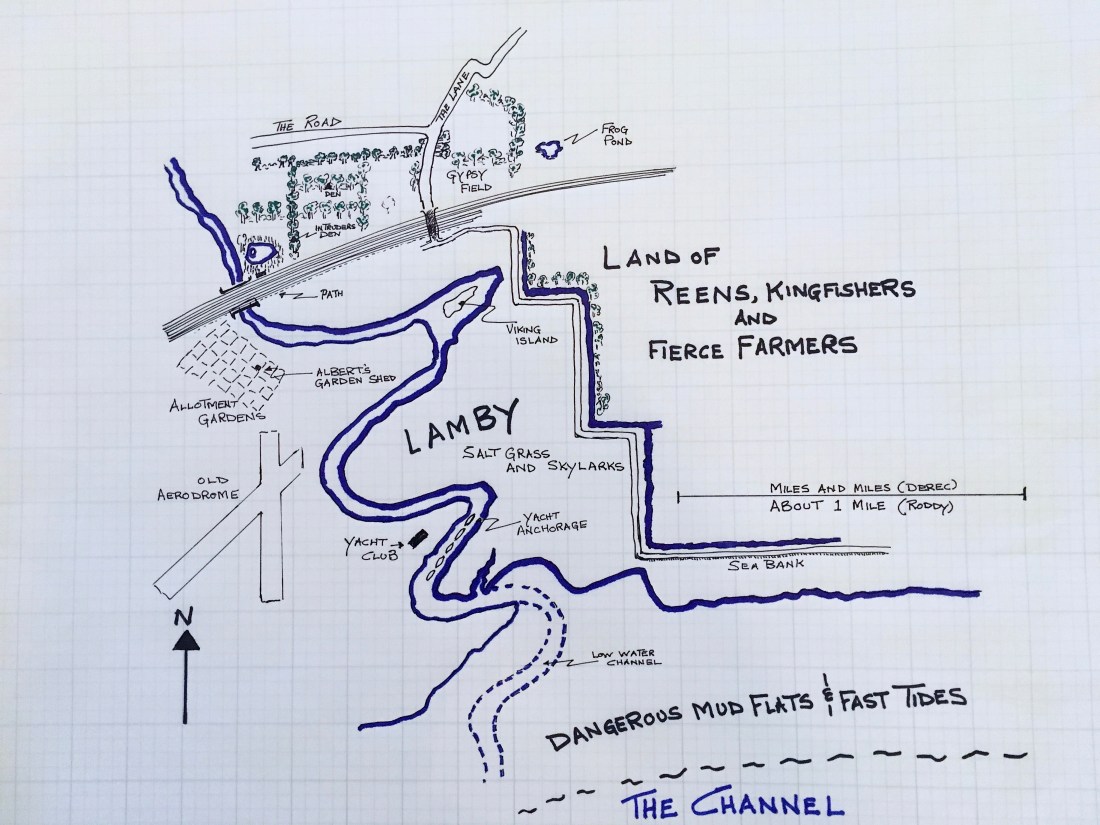
CRAZY NAKED MUDFLAT ADVENTURE

As mentioned in earlier posts, paradoxically one of the great attractions of the Lamby was its dangers. For young children there was something thrilling about the frission of fear you felt as you heard stories about being trapped in mud and succumbing to the racing tide.

The River with its muddy banks and fast moving currents was clearly dangerous although sometimes daring young boys would swim in it when the tide was high. The other place of great danger was the featureless mudflats along the Channel that stretched seemingly to the horizon at times of low tide, though if you looked carefully you could always see a thin white line caused by breaking waves far in the distance. The danger was that despite their name, the flats were not just a featureless plain of mud. The tides had carved subtle channels into the muddy plain that would fill with the incoming tide more rapidly than the rest of the mudflats making for very dangerous traps.

Further up the Channel the mud is interspersed with flat outcroppings of rocks and within these wide flat outcroppings are wide depressions that trap some of  the retreating tide. Fish, including migrating salmon would  be temporarily trapped in these ephemeral ponds and local fishermen would use nets to catch these imprisoned fish. Despite the knowledge of the dangers working these reefs for most of their lives, every so often there would be a fisherman who stayed too long or misjudged the tide and  such mistakes would result in drowning.

In the section of Channel near the Lamby, there were no rock outcroppings with handy depressions to catch tide and fish so fishermen made traditional fish traps from willow. These traps would be set at low tide and if the fisherman was lucky a fish would enter the trap on the rising tide and could be retrieved at the next low tide.

In the following story our four protagonists are tempted onto the mudflats, not by fish, but by the wreckage of a small plane that they had often wondered about. How it got there was a mystery to them but that did not stop them concocting wild tales involving daring pilots and dogfights. All of them had knew well  the dangers of the fast moving tides but it is a strange thing about children that knowledge of danger can often be more of a temptation than a deterrent. There is also the ever present challenge of the “dare”. To be dared to do something is to be faced by a double challenge; the challenge of whatever dangerous thing comprises the dare but also the potential loss of face if one does not take the dare. What if you pull back but another of your friends takes the dare and succeeds in overcoming it. That threat of losing face often seems more terrible than the physical danger involved in the dare. In a sense this is what happened to our four young adventurers when Peter challenges them to follow him out onto the mudflats to see the wrecked plane.

Read and enjoy but don’t attempt this yourselves. Remember it is just a story and the mudflats and racing tides are truly dangerous combination.

CRAZY NAKED MUDFLAT ADVENTURE


Saturday turned into a particularly fine one once the early morning mist had burned off the fields near the River. Being Saturday Roddy and his friends would, despite the improving weather, do as they usually did on that day and go to the cinema for the morning children’s show and there indulge in the usual scrimmage bordering on mayhem that was called the “Children’s Matinee”.


This week’s show was not a particularly good one. The cartoons were a repeat of those shown some months ago and the cowboy feature was starring some new cowboy called Roy Rogers. Not only did Roddy think the name was rather bland and not at all as good as the name of his hero, Hoppalong Cassidy, but the man didn’t look like a proper cowboy. His outfit was too fancy and his horse was too clean and well-groomed to be the horse of a proper cowboy. Hoppalong was not scruffy but he always wore dark workaday clothing and didn’t have a horse with fancy reins that were covered in silvery medallion things. This Roy fellow was obviously a fake cowboy and he also had this girlfriend called Dale who kept on popping up during the film. Peter and the rest of the gang felt the same way about this imposter and they began to boo at some of the sillier scenes and when the man began to sing it was the last straw and the entire audience of children hooted their derision at the screen.


Afterwards they had no enthusiasm for going to the den and re-enacting key scenes from the morning film as they usually did. Imitating such a fake was unthinkable. This Roy fellow was not a real cowboy like Hoppalong who looked as if he had lived a hard life and dealt with really tough men out on the range. In contrast Roy Rogers, in his shiny white and cream clothes and his horse that looked as if it was more at home in a horse grooming competition than out on the range as the mount of a hard riding cowboy, was just not believable. The entire Gang thought that the morning show was not worth imitating or even discussing, as they would have done for hours after seeing Hoppalong Cassidy in action on the silver screen.


So they began to talk of other things and decided that they needed to go exploring, as they liked to do when they found the home fields around their den temporarily unexciting and too restricting. Today was one of those days as the disappointment with the Saturday matinee and the absence of their hero had drained their usual energy and enthusiasm. They needed some new stimulant to get them moving.


Explorations typically involved walking out on the sea bank for a little way before cutting across into the fields and daring one another to jump the reens that bounded the fields and looking for the wonderfully engineered nests of the reed warbler or looking for the elusive kingfishers that glinted their way swiftly through the reeds of some of the larger reens. There were many fields to explore but often these walks ended up at the old wartime army camp with its brick shelters and concrete pads that once held the anti-aircraft guns. For the boys the War was a constant fascination and they were always trying to find abandoned military items. One boy in their school made them very envious and at the same time more avid in their searches when he showed them the dented and scratched helmet that had he said once belonged to an American soldier. Such an item would have become a gang treasure and a major prop in their war re-enactments if they had been lucky and found one.


But today, instead of diverting into the adjacent fields, they continued to walk along the sea bank, as their goal was another wartime relic and one that they had often discussed but never visited because of the danger involved. It was Peter who had suggested it for, as they walked across the railway bridge to gain the sea bank, they had all noticed that the tide was ebbing and the current was flowing fast, and already the River was well below its muddy banks. Soon the water would be low enough to expose the rocks that littered the bed of the River, at which time the River would grow loud with the sound of swirling and gurgling as the water rushed over its rocky bed. All of them agreed with Peter’s suggestion while inside each felt a prickling of fear, for the relic was the skeleton of an aircraft that sat on the mud flats that at low tide would stretch for what seemed miles.


They had often stood on the low grassy “cliff” that marked the limit of the highest tides for most of the year and looked out at the wreck and watched the incoming tide swirl around it while arguing over what it was. The popular opinion was that it was the wreck of a fighter aircraft., perhaps a Spitfire, that had taken off from the nearby aerodrome across the River and had been shot down by a roaming Messerschmitt. Romantic and appealing, as this story sounded, it came straight from their imaginations without any benefit of fact. Much as they wanted the wreck to be that of a Spitfire the shape of the skeleton of the wreck was too fat and lumpy to be that of a sleek Spitfire or even its slightly less romantic sibling, the Hurricane. Although they were not sure what it was they had no idea how to find out, but their unspoken suspicion was that it was some minor and unexciting aircraft that was probably already ancient when the war began.


Nonetheless it was an intriguing mystery but they had never ventured out to it because it lay far out on the dreaded mud flats and they had been told over and over by parents and adults to stay off them because of the danger of either sinking into the mud or being caught by the brown rush of the incoming tide. Often they had stood and watched the racing tide and had wondered what it would be like to be caught on the mud unable to move while the fast-moving tide raced around and then engulfed them. The thought of what might happen triggered a little shiver of fear that usually caused them to quickly abandon any thought of walking out to the plane wreck over those dangerous tidal flats.


So, adult warnings aside, they had never been tempted to go out over the mud and look at the old wrecked plane. Why Peter suddenly suggested that they do so was inexplicable except that they knew that he was the most daring of the gang and a great risk taker. When Peter suggested some new adventure, such as climbing tall trees that they had never even attempted before, the rest of the gang were reluctant to say no and although fearful would at least try to go some way with him in whatever adventure he had proposed. All of the boys in the Gang wanted to be seen as brave and fearless by his friends, so no challenge was refused lightly.


But this was different as none of them had any experience of the mud flats and, unlike climbing trees, something that they had all experienced to some degree even if they were not as strong and athletic as Peter, the twin threats of a racing tide and sucking mud worked as powerfully on their imagination as the prospect of meeting an ogre or a ghost.


So they continued walking along the sea bank behind Peter who now had a determined look about him and was starting to walk faster and faster as if he knew that the window opened up by the retreating tide was not long and they needed to follow the retreating tide in order to gain the maximum safety. As they walked Roddy looked about him at the expanse of short salt grass on his right and the fields, hedgerows and reens on his left. It was a rare sunny day and the air was full of the songs of skylarks singing at the top of their trilling voices to ensure that these earthbound invaders stayed away from their fragile but almost invisible nests tucked into the folds of the salt grass. He wondered how they knew to make their nests, lay their eggs and teach their young to fly before the spring tides inundated their nest sites. Why didn’t they just go into the adjacent fields though it did strike him that they too were dangerous places with haymaking and cattle that could easily tread on a fragile nest despite the lark’s desperate attempts to lure them away. The more that he thought about this the more he recognized that birds were rather clever creatures to have worked this out in their very small heads.


With these thoughts of Nature’s wonders whirling through his brain he barely noticed that they were already close to the place where the sea bank took a major jog to the left and ran more or less straight along the coast to the next town. One day he promised himself that he would walk along that part of the sea bank where it acted as a sea wall to protect the low lying farmland that lay behind. In front of the sea wall was a flat area of sea washed turf that ended in a vertical cliff of hard mud that separated the short grass from the watery mud of the foreshore proper. The mud cliff had little coves carved into it just like a rocky cliff face, that it resembled in solid-mud miniature. In some of these there were small half-moons of beach made of sand and broken shell that looked incongruous against the muddy expanse of foreshore.


Peter left the sea bank and strode across the salt grass to the edge of the mud cliff and looked out at the retreating tide. Turning the others he told them that they really needed to get on as the tide was now well out and as they never even knew about the existence of tide tables, they were unsure about how much time was available before the tide turned and conditions became unsafe. What they did know from observing the incoming tide in the past was that it swept across the flats very quickly. The question facing them was how they would get down on to the mudflats without getting themselves covered in mud. Then they needed to decide what to do with their shoes and socks, as they could not wear them to cross the mud. Keeping their shoes free of mud was vitally important as they would be impossible to clean thoroughly and dirty shoes would be clear evidence of their where they had been and would lead to questions and more questions, until they finally stumbled over their inadequate fabrications and were forced to tell the truth. No, they would have to do this barefooted and they had little experience of going barefoot outdoors other than on sandy beaches. This mud would be a different matter completely.


Their unease grew as they walked along the foreshore to a place that was nearly opposite the wrecked plane. They found a place where the mud cliff had crumbled, making it easy to scramble down without getting too dirty. It was at an indentation in the mud cliff that formed a miniature cove that had trapped some sand and broken shells making a narrow curve of beach over the otherwise omnipresent mud. Peter went down first and sat down on the patch of sand and began to remove his shoes and socks, carefully folding the long grey socks and pushing them into his shoes. The others scrambled down to where Peter was sitting and began to fiddle with their laces but with little urgency. They all realized that they had gone along with Peter’s suggestion without any argument or discussion although none but Peter seemed to have any enthusiasm for this daunting escapade. As Peter finished taking off his shoes and socks and carefully setting them together on the patch of sand, he looked across and saw that he was the only one to have done so.


“What’s the matter”, he said in a voice so challenging that it was almost belligerent.


Silence. Not one of them dared to be the first to open their mouths as they knew that Peter’s commanding manner could easily turn to anger and that anger would be focused on the first to speak against his idea.


“Look”, he said, “the tide is well out and we don’t have to walk very far to get to the plane and the mud flats are not called flat for no reason. They are as flat as anything. Just look. It will be easy.”


More silence from an apparently cowed Gang, a silence made more embarrassing as it was in deep contrast to the faint rumbling sound of the waves breaking in the far distance. Finally, Derec broke the silence.


“But won’t we sink in the mud and get stuck and then drown as the tide comes back.”


Peter looked at him in disbelief that his own brother could be so scared of a little walk on the mud and worse, strike a blow at his leadership by suggesting that his idea was too dangerous. His reply was to get up and walk to the edge of the crescent of fine sand and broken white shells, then continue onto the mud of the foreshore. After a while he stopped and turned back to face the other boys who were watching him earnestly and with some concern that he would not suddenly sink into a pocket of soft mud.


He put his hands on his hips and looked at them defiantly.


“See, I’m not sinking in the mud. It’s just a thin layer of slop and beneath that it is pretty solid. You don’t have to slip on your bum either as all you do is just curl up your toes and dig them in to keep your balance.


The rest of the Gang looked on in dismay as he had now made it almost impossible for anyone to not follow, just as he did when he was leading on a new tree-climbing route. They were being shamed into following him onto the mud flats and there was no way to resist, at least not without being shown-up in front of their friends. So, slowly, they took off their shoes and socks and lined them up with Peter’s. Then reluctantly with much hesitation, they walked toward the edge of the tiny sliver of sand and broken shells. Peter looked back at them for a moment before turning and starting off again toward the wrecked plane.  Walking steadily and carefully and taking some care as to where he put his feet, he moved steadily across the muddy plain. They could see that he wasn’t slipping or falling on his bum and getting his clothes dirty. Suddenly they realised that he was now quite some distance from the little sandy strand and the gap somehow looked quite frightening. As their leader continued to recede into the flat grey-brown of the tidal flats, they stirred from their fearful trance and began gingerly to walk onto the mud flats.


Luckily all they had to do was follow the smeared indentations in the sloppy mud that marked Peter’s track. It suddenly struck Roddy that his feet were not sinking deeply into the mud as they had so often been warned would happen. Just below the top layer of liquid mud that was the surface, the ground was quite hard, even solid just as Peter had said. This was a real surprise and some of his anxiety began to flow away and his body began to relax. He called to the others and found that they too had noticed and were relaxing more. They all began to look around them and take in what was becoming a pleasant day after a cool and cloudy morning. The breeze was from the south-west, which meant that it was blowing up the Channel, usually the direction from which the big storms came, but today this wind was light and it seemed to warm them as they trudged further and further out toward the distant thin line of breakers that marked the lower limit of the tide. The bright sun seemed made everything seem safe and pleasant and they became more light-hearted and even began to talk to one another and exchange jokes and banter.


Roddy was looking around him with more interest and he realized that the apparently flat and monotonous expanse of mud was an illusion. Cutting across the mud flats were sinuous shallow channels that looped and split as they neared the shoreline. The difference in height was not great and they were quite gentle for the most part but he also noticed that some of the larger ones had steeper sides and that some water still lay in the bottoms of these shallow gullies that wound back on each other like snakes. He looked ahead to see that Peter had also noticed this and was now stopped on the side of one of the deeper gullies and clearly hesitant about crossing. The rest of the group caught up with him and looked down at the obstacle, for that is what it was. The sloping sides were not too steep but steep enough that they could easily slide and lose their balance and land in the mud. That would be a disaster as if their clothes became smeared with thick grey-brown mud it would be almost impossible to remove. They looked to Peter for a decision but he just continued to stand there, looking, and then he suddenly turned and looked back to where they had left their shoes and then back to the gully at their feet and then off toward the wrecked plane that still seemed to be as far away from them as when they began this trek.


Then he turned to them and said, “We must go back to shore and leave our clothes there.”


The Gang was stunned and looked at him wordlessly before Clive was able to gasp out a protest. They had never been without clothes in all of their games and while they had seen some older boys swimming naked in the River on a few summer evenings, they had never wanted to copy that and had never even discussed it.


“We can’t go without clothes. Someone will see us and report us for being naked in public.”


Peter, no lover of authority, looked at him with a sneer, “Who will see us here and what will they report. We are miles from the fields and hardly anyone comes out this far on the sea bank and we are not even near the sea bank now. If one of us slips while we are still in our clothes, they will be covered in telltale mud and that will be bound to cause our Mums to tell our Dads and then we will be in big trouble. If we want to go to the plane wreck again we would never be allowed and they might also ban us from coming to the Lamby, and what would we do then.”


They could see his logic. One accident would lead to them being found out and the consequences would be drastic. Banned from all of their favourite haunts and worse, they would be under suspicion and therefore watched all the time in case they tried to sneak off somewhere. But taking their clothes off would be a big step, as they had never seen one another naked before. It was not because they had a fear of being naked or because of any potential embarrassment, but more because they had neither done it nor thought or talked about it before. Except, and Roddy was the first to articulate this, what if someone told.


“If we do take our clothes off then we must all swear to secrecy and we must have a big punishment for anyone who breaks the oath. I’m not going to do it unless everyone swears to a solemn pact of secrecy.”


They all looked at him and slowly, one by one, they began to nod. Peter looked them over and them turned and started to walk back toward where they had left their shoes. The rest fell into line behind and slopped and splashed along. The trail of footsteps was now becoming a wide irregular crease through the mud, a real track. Back at the shore they carefully climbed the mud cliff, being very careful to keep the mud from staining their clothes. First they had to wipe their feet on the short sea grass to remove all traces of mud that might stain their clothing as they undressed. Hesitantly at first, then faster as if to just get it over with, they stripped off their short wool trousers and shirt followed by their underwear. Each spent some time carefully folding their clothes in an attempt to delay the moment when they would have to stand and face each other, before laying the neat piles of clothing on the grass.


Peter saw this and stopped them.


“Don’t leave your clothes on the grass here. Someone might just see them. Let’s take them down to the little patch of sand and shells and put them by our shoes. They will be alright there and out of sight.”


So, trying hard to not stumble while carrying their clothes, one by one they lowered themselves down to the sand and shingle and found a spot next to their shoes for the clothing. Roddy carefully repositioned his shoes to a drier spot and placed his folded clothes on top of them. He did not want to risk getting them muddy and did not want to take any chances. Derec and Clive followed his example.


They tried not to look at one another as they all felt awkward and embarrassed. All that is except Peter who seemed to be focused on getting out to the wrecked plane as quickly as possible. He led the way, stepping briskly off the little arc of sand and shells onto the muddy foreshore. The others walked slowly after him, limping slightly on the sharp shells until they too finally reached the foreshore mud, which felt so smooth and soft in comparison. Taking care not to stare at each other, they walked in single file back along the muddy scar that marked their previous attempt to traverse this sloppy mud plain.  In order to keep from slipping and falling, they had to adopt a sliding gait and keep pushing down with their toes to maintain balance. The passage of many sliding feet had formed a furrow exposing the slightly pinky-grey coloured mud that lay beneath the darker gelatinous top layer.


Soon they reached the gully that had caused them to turn back earlier and they all stood looking down and discussed how to negotiate it. Peter, taking on his role as leader once again, was walking back and forth along the side of the gully trying to establish the best crossing point. Clive meanwhile decided to push ahead and attempt the crossing immediately. The others watched as he made the tentative first steps down the gentle slope and by digging in his big toe he was able to keep upright. The further he went the greater his confidence and he began to lengthen his stride a little from the short tentative sliding steps that he had taken at first. The rest, except Peter, watched tensely as if expecting disaster to strike soon. Clive was gaining confidence with every step and he turned his head to tell the others to come on and follow, when he took one step that was a little longer than the others and suddenly his right leg shot forward and his body became airborne for a brief moment before falling back into the mud with a wonderful splatting sound and he slid the last few feet to the bottom of the gully where he lay briefly on his bum and back before raising himself with his elbows. The faces of the watching boys flashed from gasping concern to one of joyful grins as they saw Clive struggle to his feet and show a bum that was completely covered by dark brown mud. At that point they could not help themselves and they began to laugh and point at Clive’s muddy bum. Clive had landed mainly on his buttocks and then fallen back on to his shoulders so that the mud left two large splotches of mud on each buttock cheek and a broad patch across his shoulders. In between there were just a few mud splatters on his smooth white skin.


The effect was to emphasize his bum and make it stand out grotesquely like the effect that clowns sought with their makeup. “Clown bum”, shouted Derec, and at that moment all the nervousness and fear that had marked the journey so far evaporated in hoots of delirious laughter. This was not going to be too hard after all. The air was warm and the sun had warmed the glutinous mud sufficiently so that getting it over your body was not so terribly uncomfortable, they were not going to sink without trace into some mud hole and falling over might even be fun.


Peter meanwhile had found a place where the slope of the side of the gully was less steep and he had carefully walked down and across the deeper layer of sloppy mud on the floor of the gully, and was taking the tentative first steps up the far side. The rest of the Gang needed to chose between following Clive and perhaps falling as he had done or taking the less slippery route and keeping themselves free of mud, at least for the moment. They chose to follow Peter and they all made it across this gully without falling. Clive had managed to climb the other side and they walked over to join him. Peter looked at Clive and gave a fleeting smile before resuming his walk toward the skeleton of the wrecked plane. The others quickly followed as they saw that they was some way to go and they sensed a new urgency in Peter’s gait.


Time was passing and they still had several hundred yards to go to the plane. Luckily they only encountered one more gully but this one was more difficult to traverse than the first one and both Derec and Roddy slipped and hit the mud before sliding down to the bottom of the gully on their bums. They now had more mud on them than Clive and he was now able to laugh at their expense. The tables had been neatly turned. Only Peter with his keen sense of balance was able to avoid falling and his body was still pristinely white in contrast to the backsides of his fellow gang members who, from the rear looked like badly made up actors in a comedy show.


Finally they reached the plane and Roddy looked back to where they had left their clothes and was surprised to see how far away it was. Much further than he had judged when looking at the plane from the shore. The others had not noticed him looking back as they were busy walking around the wreck. It was thoroughly corroded by the sea and the mud. Only the skeleton remained and there was no sign of any instrument panel or any other parts that they could rip off and take back as souvenirs. It looked as if the plane had been thoroughly stripped already and they decided that as it had crash-landed within sight of the aerodrome, perhaps mechanics had been sent out to strip away anything that was valuable. Even the pilot’s seat was missing and the engine that had sat at the front of the fuselage was also gone. Only the frame of the fuselage and the struts of the wings, now almost completely covered in mud, were left.


Naively they had imagined that there would have been enough left of the plane that they could sit inside and pretend to be fighter pilots struggling to land their damaged plane after a tough but successful dogfight in which an enemy plane had been shot from the sky, trying to keep the plane on course for base so that they did not have to land in the grey blustery Channel with its fast currents and strong winds. Instead all that they could do was look inside the bare corroded skeleton of a fuselage and feel disappointed.


Just then Clive shouted and pointed toward the sea. The thin line of grey-white that marked where the waves were breaking on the far mud flats was much closer than it had been a while earlier and, what was more worrying the line was getting perceptibly closer by the minute.  All of them remembered the stories of people who wandered out on the flats being caught by the tide, which came in at great speed. Even experienced fishermen, who had gone out to empty the willow fish traps that they had set to trap fish on the incoming tide, as their ancestors had done for generations, were sometimes caught out and drowned.


The sight and the sound of the incoming tide sent a shudder of fear through the group and Derec in particular began to panic and shout that they should start back to the shore, and soon. Only Peter seemed unworried by the incoming tide and, after a glance at the advancing white surf line, he continued to search around the aircraft wreck without appearing to be in a hurry. Roddy could not understand what he was doing. The expedition to the wreck had been only moderately interesting and the wreck itself was hugely disappointing, just a bare skeleton. There were no weapons or guns or other stuff that could be stripped off and taken back to the den and used to impress other children that they were tougher and more adventurous than others and not a gang to be taken lightly. Instead there they were, naked and with mud splatters over their legs and bodies and if they came back without anything they could never tell anyone else for revealing that they had to take off all of their clothes would just cause people to laugh and their Gang would become a Village joke. As he was looking down at the muddy slop around his feet and contemplated the potential humiliation that would come from this expedition, he was suddenly shaken out of his dismal reverie by a shout.


Peter had wandered away from the wreck in his searching and now appeared to Roddy to be quite a way toward the advancing line of grey white that marked the breaking waves of the incoming tide. He was waving wildly at them and also looking down at something by his feet.  Clive and Derec were just standing and watching. Clearly they were reluctant to go any further into what appeared to be an increasingly dangerous place. Roddy looked back toward Peter and wondered what on Earth he was getting so excited about and why he was not returning and hurrying them back toward the shore and safety. Reluctantly he walked over toward Peter noticing that the sloppy mud thickened as he walked further seaward from the plane. When he reached Peter he saw that he was digging around something that lay partly buried in the mud. It was a shell or a bomb, Roddy was not quite sure which, but his first thought was to run away as he had heard all about unexploded bombs. Peter and Roddy looked down at the bomb or shell. They were unsure of what it was.


“Peter, I think it is a bomb and we have been told that they are dangerous and that we should keep away. Come on; let’s go back now. Leave it!”


But Peter was not going to be deterred. He too had been thinking about how this whole episode would look if word of it got out to others and he knew that Derec was likely to gab at the first opportunity to embarrass him. Not only would the gang face jokes and laughter as the details were embellished, but Peter as the one who had suggested this in the first place, would have to bear more than his fair share of humiliation.

It was a great disappointment to have not found some striking prize from this adventure that would make the entire thing seem heroic and madcap to anyone else, and perhaps it was because of this deep sense of being cheated that he suddenly decided to take the shell. It was just over a foot long; a grooved cylinder joined with a smooth cone. Too large to be a bullet they thought but not really a proper bomb like the ones that they had seen falling out of the bomb bays in the many war films they had watched. It was a puzzle but not one that they could be bothered to work out even if they wanted too.


“When I said that we ought to finally come and look at the old plane wreck, I was really hoping for some sort of souvenir to show that what we did was not just daring but worthwhile. If any of our mates find out that we just came out here naked and found nothing we shall be a laughing stock and the butt of jokes for months. I am afraid that my brother will accidentally blurt out something. Taking this shell back would be something really serious and it might help to keep my brother from blabbing.’


“But what if it goes off?”


“Nah! Don’t worry about that. It has been lying out here in the mud and been covered by the sea twice a day for years. I would think that it is just a dud.”


As if to reinforce his belief, Peter gave the shell a push with his foot. Roddy winced and instinctively turned away as if expecting a big bang. Nothing happened.


“See, I told you so. Now if we take it back with us, I can use it as a way of keeping Derec quiet by telling him that we will get in trouble with the police if this comes out. That way he will have to keep quiet about the entire adventure.”


Roddy looked quizzically at Peter. He couldn’t quite explain it but he too suddenly found himself interested in doing something quite daring. Like Peter, he felt that just coming out to the plane wreck and having to strip down to do it was somehow a bit weak and embarrassing.”


“Alright, I’ll help”


Peter and Roddy again looked silently down at the shell. Well if they were going to take this thing back, they had better get started. Peter was probably right. While the risk of it “going off” was unknown, it had lain here in the mud and the sea for a long time and was probably harmless by now as long as they did not bump it too hard.  The certainty of humiliation was much more likely, and to these proud Gang members, a much worse fate to bear. For an adult, the logic of leaving the probably unstable shell where it lay would have been inescapable. But for Peter and Roddy the fear of the shell exploding was overwhelmed by the threat of shame and embarrassment and thoughts of reckless accomplishment.


Roddy bent down and began to help dig the shell out of its shallow muddy grave. Even though the soft sloppy mud layer was thicker here than it was closer to shore, there was still a layer of hard mud below and the shell was partly in the grip of this harder mud and they only had their hands with which to scrape and scratch this away.  Peter took hold of the conical end of the shell and gave it a good yank. It did not move much as the sucking mud continued to hold it firmly. They dug some more and with more urgency as they both heard the sound of the breaking waves getting louder, and that meant that time was running out. Peter tried again and this time the shell moved a little. Once more he tried and again failed to dislodge the shell. Roddy suggested that they should both try it, so they maneuvered themselves one behind the other so that they could place all four hands on the cone of the shell and in unison pulled on the shell which suddenly yielded with a loud final “suuuuuccckkk”. It came so quickly that they fell back into the mud with Peter almost sitting in Roddy’s lap, and sat there in surprise until the embarrassment of their position caused them to scramble to their feet, scattering more mud slop over themselves in the process.


They looked down at their prize. It was covered with mud and the metal had lost its sheen and was just a dull grey colour. “We could clean it and polish it quite easily”, Peter said optimistically. “It would look very good at the entrance to the den. It would impress those City kids and perhaps frighten them away”.


Roddy agreed, but his concern was how they were to get it back and how quickly they could reach the shore ahead of that surging line of breakers. “Yeah, perhaps, but the first thing that we have to do is get it back to the shore before the tide overtakes us. Come on let’s hurry”.


They each took and end of the shell and began to carry it back to the others who were still standing near the wrecked plane waiting for the signal to start the walk back. The shell was not so much heavy as awkward. It was too heavy for one of them to carry far, but for two the problem was one of coordination, as they had to match their pace to avoid stumbling. They reached the wrecked plane and put the shell down. Clive and Derec looked rather scared as they stared down at the squat shell.


“Will it go off?” said Derec in a wavering voice.


“No, it has lain here in the mud for years and is probably all wet inside and you know what happens if you get fireworks wet before Guy Fawkes and how they can just fall apart. Come on we need to go now”, Peter said, as he looked back toward the advancing tide that was now fast approaching the spot where the shell had lain. “Quick, let’s get going. We need to take it in turns to carry it. Come on Clive and Derec, it’s your turn for a while, we carried it this far”.


Both boys started to argue with Peter but he just gave them a withering look and they gave in. Together they lifted the shell and started off toward the shore. They found it difficult to coordinate their pace and worse, their difference in height and strength made the task more complicated. On they struggled, slipping often in the slick mud and straining to keep their balance and not drop the shell as it had occurred to them that, despite Peter’s assurances, if they dropped the shell it might be enough to make it go off. Finally they could go no further as they had weakened, so it was the turn of Peter and Roddy to take the shell and continue.


So, slowly, too slowly it seemed, they trekked back to the safety of the mud cliff while behind them the dirty white line of breakers came closer and closer accompanied by the rushing sound of breaking waves. Finally they reached the first channel in the mudflat and were dismayed and frightened to see that the tide had got there first and a strengthening wind was driving small waves up the channel and over their path to safety. Peter looked around to see if there was a way around. They could go through the rapidly filling ditch but they were not sure how deep it was.


Peter told Clive and Derec who had been carrying the shell to put it down and hurry to the shallower crossing point that he had used earlier. They tried to run, driven by the overwhelming fear that they might be completely cut off from the shore and trapped between the gully and the advancing waves behind. But running on this slippery mud was not easy and as they hurried along they slipped more frequently and then the inevitable happened and Derec lost his balance and did a spectacular spin as his legs accelerated forward and left his body suspended momentarily in mid-air before it smacked, backside first, into the mud sending out sprays of brownish slop. It would have been funny if it were not for the noise of the waves surging up the gully and made worse by the wind which had now changed from the balmy breezes of a few hours ago to a cool stiff wind that was churning the sea and was even beginning to make a moaning sound as it blew over the flats. The morale of the group was sinking fast and there was a strong sense of fear that caused their faces to harden into solemn masks.


Both Peter and Roddy knew that they had to do something quickly. Derec was sobbing after his fall and Clive was standing hesitantly at the edge of the gully and looking back at them. Neither Derec nor Clive was moving to cross the gully and the waves that were sloshing up the gully seemed to be getting larger and noisier by the minute. The situation was getting serious and there was no one around who would hear their cries for help. While Roddy knew that he could swim, he was unsure that he could manage to negotiate the fast-moving tide and he did not know who else in the group could swim. He decided that the best thing was to abandon the shell on the side of the gully and make a dash through the gully and the muddy waves for the other side and then run up to a point opposite Derec and Clive and help them across. This would be faster than running along the seaward side of the gully and would also mean that one of them at least was on the landward and therefore safe side of the gully.


Before he could move Peter shouted at him to hold the other end of the shell and move across the gully. His voice was so commanding that Roddy didn’t even think of how this would work. As if in a trance, he did as he was told and they moved down the slope of the gully and into the surging tide. Strangely, they did not slip uncontrollably as he thought that they would, instead the water around their legs seemed to act as a stabilizer, allowing them to move more easily over the muddy floor of the channel as if the water was sweeping off the sloppy and slippery surface mud and leaving the rougher harder surface of the under layer for them to walk on.  To their amazement they reached the other side quite quickly and without falling and they carefully made their way up the slope using their toes to dig in and gain a stronger foothold.


Seeing them cross the gully broke the spell that had immobilized the other boys and they too decided to make a dash for safety, driven partly by the possibility that they were being left behind. Now there was just one more obstacle, the shallow gully they had first encountered on the journey out, before they could hurry to the little sand and shell beach below the mud cliff. They were now in relative safety and the rictus of fear that had gripped all of their faces faded and was replaced by broad grins. Not only had they beaten the tide but they had also beaten the potential for humiliation. They now had the shell and they had an adventure story that would impress all of their friends who were still in thrall to the severe warnings of elders to never venture out onto the dangerous mud flats. They had ignored those warnings and had survived and beaten the angry tide. Already the embellishments to the story were surging through their minds and causing the truth to twist and fade into the mists of imagination and mythology.


They hurried as fast as they could with the burden of the shell. Peter and Roddy carried it most of the way as Derec was not very good at holding the shell and keeping up a reasonable walking pace. The tide was still advancing quickly but there were no serious obstacles ahead and the last shallow gully was easily crossed. Moving quickly now, they were able to at least match the pace of the water’s advance. The wind was freshening however and the pleasant, warm breezes of the morning were now a memory and their naked bodies were becoming chilled.


Roddy looked toward the shore and the nearby sea bank scanning for people. He could not see anybody but they had not been paying any attention to the possibility that others may have watched them trekking out to the plane wreck. Perhaps someone had raised the alarm already and perhaps even told the police who might be on their way now. The thought made his stomach knot up and a hot nervous flush surge through him. They were not safe yet. All of them had splotches of grey-brown mud on their naked bodies and they had not even thought of how they were to clean themselves properly so that they did not arrive home smelling of the pungent Channel mud.


When they arrived back at the small sandy patch that filled the notch in the mud cliff, they carefully put the shell down and looked at how they might carry it up the cliff itself. Although not high it was an awkward scramble and the hard mud could easily crumble while in places it was slippery and the thought of falling back from the cliff with the shell in their hands suddenly loomed in Roddy’s mind. The more he thought about this and the problem of cleaning up properly so that they would not smell of putrefying mud, the more it struck him that the perhaps entire adventure was a bad idea after all and that nothing but trouble would come of it


“How are we going to get ourselves clean?” he asked the others who were looking out at the advancing tide, “and what are we going to do with this shell? We can’t go home like this covered in mud and smelling as if we had fallen into a reen full of duck weed, and the shell is too heavy to carry all the way back to the den. Besides, someone might see us”.


The others looked at him blankly. They were so happy to get out of the danger from the racing tide that they had not even thought about these things. That is all except Peter who had indeed been thinking about these issues at the same time that they were whirling through Roddy’s mind. Peter quickly had them cutting and stamping steps in a collapsed part of the mud cliff that they had come down earlier. They manhandled the shell up the cliff, just barely avoiding sliding back down with it. Peter then looked around for a place to hide it which was very difficult on a flat expanse of salt grass, but luckily a turf cutter had been working nearby and had started to cut the sods in squares before stopping for some reason leaving a square hole in the otherwise flat and endless turf. They placed the shell in this depression even though it was not quite deep enough to hide the shell completely, but it did make it look less conspicuous, especially if they pushed it against the side closest to the sea bank so that someone walking there would be less likely to see the shell.


Now they needed to clean the mud of their bodies and there was no water around to do that, except the sea, and that was not the cleanest water as the incoming tide was stirring up the fine mud layer that lay on the tidal flats. But there was no choice and they started to go back down the mud cliff after first reassuring themselves that there were no people walking along the sea bank.


Roddy suddenly had an idea. “Lets scrape off the worst of the mud first and then we shall not have so much to wash off”. So they used their nails to scrape away the worst of the mud and were surprised that so much came off in thin flakes. The sun had helped dry them off and the strengthening wind though cold and uncomfortable had done the rest. All that was left was to clean off their feet and to do that they clambered down the mud cliff once more, taking their shoes with them so that they could put them on after washing so that they did not get mud over their more or less clean feet. The sea was cold but they bravely stood at the base of the beach and as the waves came swashing in they scooped up the water and helped one another to wash off their muddy feet then they slipped on their shoes and carefully climbed back to their clothes and dressed. It was strange to see themselves clothed again after getting used to being naked savages. Never before had they seen each other naked and now that they were dressed normally again, it just seemed like it had never happened.


It was time to start back but before doing so Peter and Roddy made everyone swear a solemn oath to not breathe a word of what they had done to anyone and emphasizing that if word got out to parents or other adults, they would all be in deep, deep trouble.


“Let’s wait until we get the shell back to the den before saying anything to anyone about this”.


Without the proof of the shell it would be impossible to make anyone believe what had happened and their half-baked adventure would just make people laugh at them. They all swore solemnly to not breathe a word and Roddy reminded them that to break that pact would make the person who squealed look as foolish if not more foolish than his fellow Gang members.


So, with the shell hidden as best they could and with most of the mud scraped or rubbed off their bodies, the disheveled group started the walk to home leaving a faint pong of fetid estuary mud in their rear. Roddy hoped that his mother was out shopping or doing something that would thoroughly distract her so that he could sneak upstairs and give himself a thorough wash and get rid of the smell of their reckless adventure.

DEREC THE HERO

In the Great Chicken Rescue the three boys had gone to see the great flood on the River and saw a chicken coop with chickens inside floating on the roiling brown flood waters. The two elder boys, Peter and Roddy, decided that they would try to save the chickens and, assuming that Derec was close behind, they ran as fast as they could to the yacht anchorage downstream to seek help. So focussed were they that they ran off without checking to see if Peter’s brother Derec was with them and then they were so immersed in the  chicken rescue that it was not until that drama was over that they realised that Derec was nowhere to be seen. In panic they ran back to where they had last seen the chicken coop floating down the River with images Derec having suffered some awful fate flashing through their guilt ridden minds.

Below is the story of what happened next


Arriving at place on the River bank where they had last seen Derec, they looked desperately for any sign of him. Despite carefully scanning the riverbank he was nowhere to be seen. Roddy could see that Peter was beginning to wonder if something terrible had happened to his brother and was beginning to panic. Roddy could not believe that anything bad had happened to Derec, after all Peter’s younger brother was cautious and rather fearful of trying new things or even facing slightly dangerous situations; always the last to try new tree climbing routes that his brother pioneered and often refusing to follow the rest of the Gang on one of their hair-raising escapades. No, there had to be some other explanation for his absence from the chicken coop episode.


They continued to look anxiously around them, scanning the flat terrain for any sign of Derec. After all, in this flat country there was almost nowhere to hide unless you could find a slight dip in the grass, perhaps caused by some old river current that long ago had deposited less mud there than elsewhere. Even then, if you wanted to hide you had to push yourself into the ground to make yourself inconspicuous. If Derec was still here he must be visible and they could not conceive of any reason that would have caused him to leave or why he should attempt to hide.  The boys stood back-to-back and, shading their eyes from the bright sky light, they carefully searched around them for signs of the missing boy. It was Roddy who finally detected a movement near the River bank and well inside the big bend that the boys had earlier had to circumvent in order to outpace the chicken coop. Yes, there was definitely a movement and strangely it looked as if there were two bodies there. Nudging Peter he pointed to where he could still see some movement. Whatever caused it was just below the edge of the River bank and for that reason, more difficult to see.


“What is he doing?” enquired a perplexed Peter; “it looks as if he has someone else with him.”


Clearly the only way answer that was to go there and find out, so the two boys started to run again, only this time with a sense of relief that was evident in their more relaxed jogging, compared with the tense fast run that had brought them back to the spot where they had left Derec earlier. As they neared the cusp of the great bend in the River, they could see that he was crouched just below the grassy bank, and was busy with something. Neither boy was quite tall enough to see what it was until they were almost on top of him.


“Derec, what are you doing”, screamed Peter, letting out all of the worry and frustration that had been building inside him since he had realized that he had completely forgotten about his brother.


Derec turned to them with a complete lack of concern. Instead his face was suffused in happiness.

“Look at what I found!” he shouted back at them with a broad self-satisfied beam of pride spreading across his round face.

The two boys arrived at the edge of the grassy bank, their chests heaving and panting from the relief at having found Derec alive and unharmed as with their recent exertions. They looked down to see a dog, not just any dog but a very large and muddy dog that Derec  was trying to clean up. It was lying on a slab of grassy bank that had sunk toward the River and while its tail was thumping contentedly, it was lying very still as if ill or hurt. They looked at Derec who was carefully cleaning the caked mud from the dog’s flanks and at the same time stroking and talking softly to the animal. The dog was looking directly into Derec’s eyes with a look of utter adoration.


“What, where?” sputtered Peter whose face was a mix of puzzlement and consternation.


Derec looked calmly at his brother and announced, “ I rescued him from the River!”


Peter was so shocked by what his brother had said and all that it implied in terms of the danger that he must have put himself in to accomplish this rescue, that all he could do was stand there, slack-jawed, and stare at his younger brother. As well as the picture of a catastrophe that was playing through Peter’s imagination, there was the issue of Derec’s fear of anything that was new and even remotely dangerous. Something very profound had just occurred and Peter suddenly realized that his brother was no longer the rather scared and docile boy that he had sprinted away from seemingly just a short while ago. Derec continued to take care of the dog and as he patted, stroked and wiped away river mud he began his story.


When the older boys ran to cut off the chicken coop to seek the help of the men at the yacht anchorage, Derec had felt slighted that they would run off as if he did not exist. It was as if he did not count for very much and was just a junior appendage to their adventures. He was so upset that he decided that he would just leave them there and make his way home. That way, when they missed him, they would be become worried that something terrible may have happened and then they would have been scared at the prospect of going home and explaining everything to his parents. That would really give them a good shock and teach them a lesson he thought. So he turned to walk back up the River to the railway bridge and the Lane to home.


It was then that he saw the dog. It looked about the size of a Labrador Retriever but was more brindled with a long tail and a brown snout and it was balanced on a brushy branch that was bobbing and twisting its way along with the flood. The dog was yowling pitifully and it was a miracle that it had not been swept off its footing. Luckily the branch was not just a single log but also a substantial portion of a tree and despite the bucking and churning of the flood, it was relatively stable. The smaller branches that stuck up from the main part of the log, acted as a restraint to help the dog keep its balance. Immediately and without even thinking it through, he knew that he had to save that poor animal but he had no idea as to how to do it. Turning around he jogged along the bank of the River keeping pace with the dog on its brushy floating island, while madly trying to think of some way to rescue it.


One possibility was to just follow it to where his brother and Roddy were already alerting the people at the yacht anchorage about the chicken coop. If the dog could keep its balance and the log did not collide with something or start to sink, maybe someone there could save it. However, the brushy branch holding the dog was swaying and yawing quite a bit in the roiling current, and the dog would cry and whimper pitifully every time it seemed that the log might roll over and pitch it into the River.


Desperately Derec scanned the ground ahead of him for something that he could use to snag the log and pull it closer to the bank. It wasn’t in the middle of the stream but was closer to his side of the River, yet still too far away to reach without the aid of a long branch or something similar. As he jogged along he wished that he had a lasso like cowboys always carried on their saddles. He could then swing that loop of rope over his head and it would land just perfectly over one of the smaller vertical branches that stuck out from the log, and   he would carefully haul it to the bank. It was wishful thinking he knew but he was desperate for something and he could not help but think of things that were impractical and were only possible in the dark, sweet warmth of the Saturday morning children’s matinee.


It was then that he noticed that further downstream, a protrusion of rubble that someone had dumped on the far bank of the River caused the current to veer toward his bank and he realized that the branch would be caught in this cross current and come closer to him. In desperation he raced ahead in the hope that he might see something that he could use, or come up with some other idea. But there was nothing that he could see that would help.


Looking back he saw that he was now ahead of the branch bearing the dog and that the current was indeed swinging it toward his bank. Quickly, and without thinking, he kicked of his shoes and pulled off his socks and threw them in a heap on the grass. Then he did something that under normal circumstances, he would have never done, he began to slip and slide his way toward the water’s edge. It was quite a way down and the muddy bank was very slippery so that he often lost his footing and slipped. Each time that he did this he flung his arms behind him to break his fall, but he could not help but fall on his bum from time to time and by the time he reached the water his legs and short trousers were covered in the gelatinous grey-brown mud of the River. He didn’t care and didn’t even really feel it as his focus was now on the dog and how to rescue it. He stood on the edge of the water, with angry flood washing over his feet and looked at the approaching branch and the frightened dog.


Suddenly he had a flash of inspiration and wild hope crossed his mind. He remembered that when he went for swimming lessons in the City baths, the first thing that they tried to teach him was the dog paddle. That was how dogs swam, with their legs working away beneath them as if they were trying to walk their way through the water. Derec remembered thinking how very interesting that was and he wondered how dogs learned to swim. It seemed that they did it naturally and instinctively and this was the key to his sudden inspiration. He moved into the water as far as he could, taking care to dig his toes into the muddy bottom. It was a scary thing for him to do and usually he would have refused to even contemplate doing such a thing, but the sight of that miserable and frightened dog inspired him to sink some of his old fears and take risks. He was now standing in the flowing water that was lapping around his knees. Because of the disturbance to the current caused by the rocks on the far bank, the current was strong and he could feel it tugging against his calves. Yet there was no time dwell on this and worry about what might happen if he slipped and was dragged into the River. The branch, with the dog still desperately hanging on, was approaching and was already being swung toward his bank by the deflection in the current. That deflection was also having another effect on the already roiling flood and was pushing out big eddies in the water that began to spin and shake the dog’s tree branch. The poor dog was desperately trying to keep its footing but the branch, with all of its side branches, was now beginning to spin and roll unsteadily. Derek knew that it had to be now and he just hoped that it was not a case of misplaced hope. Whistling to the dog while slapping his thighs encouragingly he looked straight at it and willed it to make a move and jump off that twirling and twisting branch that looked as if, at any moment, it might suddenly turn over. He thought that he could see some movement from the dog that was now looking intently at him and moving its head and chest as if bracing for a jump. Derec hoped that if the dog did jump it would not become entangled in the other branches as then it might be forced under the water by the brushy log and drowned.


Pushing those awful thoughts out of his head he kept calling to the dog to come to him. The current was now sweeping the branch closer and closer to Derek’s bank but it was also beginning to cause the branch to swing from side to side. If one of those eddies caught it, the whole thing might be spun around and the dog would be facing the wrong way for a successful jump. It had to jump now as the thick branch looked as if it would roll over. It really was now or never.


Looking back on that moment he was unsure if it was luck, an accident or the result of his increasingly animated encouragement. Whatever the cause, the dog either jumped or fell into the water and realizing that the figure whistling and shouting at it was a possible safe haven, it began to madly paddle its way toward the bank. The timing was amazingly lucky for soon after the dog jumped, and perhaps helped by the push-off that the dog must have given it, the brushy branch began to slowly spin its way back out into the main current. The dog was gamely trying to reach the bank but it was swimming toward Derek and not directly toward the bank. The swift current was keeping the dog headed downstream and it looked as if it would sweep past Derek and be too far to reach.


Hurriedly changing position and with all thought of his safety now displaced by the focus on getting hold of that poor frightened animal, he somehow managed to move along the edge of the muddy water without falling over, though he did slip and slither around a lot. Just ahead there was a slight ridge in the bank that stuck out just a little into the River. Not by much, but just enough that it might put him within arm’s reach of the dog. He quickly splashed and slopped his way to the ridge of mud and moved out on it as far as he could and stepped further into the water. Perhaps because of scouring, the water deepened more quickly here, not at all like the shelving bottom that he was standing on previously. The possibility of danger flashed through his mind, but he was now so intent on the poor dog as its struggles brought it closer to the bank. Closer and closer came the dog, and yet so painfully slowly. Well, this was the final chance, thought Derek and as the dog came near he made a lunge that caused him to slip further into the deeper water, but he managed to get a grip on the dogs thick fur and he spun around and, with his free hand he pushed down through the turbid flood and grasped the muddy bottom with his fingers. He knew that if he pushed hard enough, his fingers would penetrate the harder mud below and he would be able to gain a better purchase. He was lucky and he dug his fingers into the harder mud as firmly as he could, forming a claw with his hand, and then he yanked at the dog, pulling it past him toward the water’s edge. The poor, half drowned animal, sensing that its ordeal might be over made a lunge toward the bank and safety and was rewarded by feeling his paws touching the bottom. With a yelp, it scrabbled its way out of the water and continued up the bank, sliding and scrabbling, until it reached the grassy bank, without so much as a glance back at its rescuer. Derec meanwhile, was left behind in the muddy swirling water. He pushed his other hand into the mud, gained some more purchase, and heaved himself out of the water and collapsed on his knees. He was exhausted by the combination of physical effort and the mental strain of facing such a dangerous situation. He had never done anything like this in his life before and there was no feeling of exhilaration or success, just overwhelming tiredness and a cold creeping fear as his rational brain began to play out all of the bad endings that could have been.


Slowly, he made his way up the bank to the grass with a half crawling, half crouching gait. The feel of the grass beneath his hands and the smell of the turf overwhelmed him and he finally realized that the dangerous drama that he had just gone through was finally over. For some time and completely unnoticed by Derec, the Sun had been breaking through the clouds and he now felt the peculiar and familiar warmth of the sea-washed grass.  He buried his face in its friendly stalks, his lung still heaving after his exertions. A whirl of images, fears along with a strong feeling of relief ran through his mind. He wasn’t even thinking about the dog, that creature that had been the burning focus of his thoughts for what seemed like an eternity. As he lay there panting, a warm slobbery tongue poked into his ear. Derec rolled onto his side and looked into the face of a drooling, muddy and smelly dog that was panting and attempting to lick him. Weakly raising his arms and, completely forgetting all of the troubles and the explaining that would follow his turning up at home a besmeared and muddy mess, he hugged that sodden animal to his chest. The dog, as if in understanding of the boy’s strained and exhausted mental state, also collapsed, and they lay in a heap on the grass. After lying there for a few minutes, Derec finally found enough energy to start to clean the dog of its coating of mud. It was while doing this that through his tiredness; Derek heard the sounds of Roddy and his brother calling.


Derec stirred at the sound, which was entering his brain as if penetrating a fog. The dog also stirred and he put his arm around it and began to rub at some of the River muck that was sticking to the dog’s coat.  Suddenly a wave of fatigue hit him and he realized that he was completely exhausted. It was as if all of the physical and mental energy that he possessed had been sucked out of him. Slowly the sound of shouting became louder and more coherent and he moved his head to try to locate its source. That is when he finally sat up, arms still around the dog and saw the boys look his way and start to run toward him.


Peter was struck dumb by Derec’s story. He could not believe that his younger brother, the one who always held back or found an excuse for not taking part in anything risky, had found the courage and strength to do such a thing. If he had heard the story hours or days later he would never have believed it, but there, before his eyes was the evidence; a muddy exhausted dog and his equally exhausted and muddy younger brother.


He looked at Roddy and simply said, “Can you believe this?”


All that Roddy could do was look at Peter with a face that was filled with bewilderment but not one trace of doubt. During Derec’s entire account he had stood and looked at the muddy pair in a state of slack-jawed amazement. Finally he found his voice.


“ I don’t know how you were able to do all of that?” was all that he could say at first. “Weren’t you afraid of slipping into the River and being swept away? I always thought that you were afraid of water, as you never even seemed to enjoy our visits to the swimming baths.


Peter however had recovered from his initial surprise and was beginning to think of more practical issues. The sun had now broken free of the clouds that were the final remnants of the great storm and, from the length of the shadows cast by the boys’ bodies, it was clearly late in the day. Late enough to mean major trouble and here they were with a muddy dog and an even muddier looking brother who had just taken a great risk. Everything about this was crying out that they had disobeyed one of their parents’ major rules about staying away from the water. Not only that, they had a dog, covered in mud and stinking of River that they would have to bring home. Peter’s mother did not welcome even clean dogs and there was no way to clean up this one before getting home. Then there was the awkward part of the story that he could see no way around; that he and Roddy had been off on another part of the River bank watching the rescue of chickens and completely forgetting about his responsibility toward his young brother. That was a violation of a cardinal family rule that elder children were responsible for the safety of younger ones at all times. There would be no getting around this; at least that was how he saw it. No one to turn to who could help; the muddy clothes and the muddy and stinking dog could not be easily explained and once it came out that Derek had accomplished the dangerous rescue all by himself, the very heavens themselves would fall on Peter and he knew that the punishment would be harsh and long. Worse, the incident would follow him for months, if not years and would poison relations between himself and his parents.


No doubt, this was going to result in the biggest trouble that he had ever experienced. Strangely, he did not blame Derec for all of this. What his brother had achieved in the dog rescue had greatly boosted Derec’s stature in Peter’s eyes. His little brother had suddenly become his equal and he could never be condescending to him again. No, the feeling that settled over him was one of misery as he contemplated the consequences of all their heroic actions. They could not take pleasure in what had happened and could not talk about it, or even boast a little. It would all be clouded by the rows and the restrictions from which they would all have to suffer. No more rambling across the Lamby and along the sea bank whenever the mood took him. No chance of ever being able to persuade suspicious parents to let them go on a voyage in Albert’s beautiful boat. It was all over!


Peter turned to Roddy, who looked equally dejected and suggested that they just make their way home and face the questions and the horrified reactions from parents when they realized the danger that their children had been in.


“Come on Derec, we need to get going,”


“What about the dog,” said Derec anxiously, “he has to come too. We can’t leave him here.”


“I know,” said Peter wearily, “he has to come too, although I don’t know what we are to do with him. You know how mum and dad feel about dogs in the house.”


“Perhaps I can persuade my parents to let me keep him,” said Roddy. My Father used to have a dog just a few years ago, so he doesn’t mind them and my Mother didn’t seem to mind either.”


With that tiny sliver of optimism in an otherwise very dark prospect, the elder boys turned and began the walk back to the railway and the bridge to the Lane. Derec hauled himself to his feet and steadied himself. He was still very tired after all of the exertions and excitement. Come on boy, he called to the dog even though it suddenly struck him that he was not sure if it was a male or a female dog. No matter, that was a minor point right now and could be taken care of later. The dog wagged its tail weakly and staggered to its feet and followed. Its ordeal and near death encounter in the great flood had weakened it but it gamely staggered behind the boys as they tramped along dispirited and dejected at the prospect of what might face them when they reached home.

THE GREAT CHICKEN RESCUE

Although the River Rhymney is a usually a small gentle stream, there are occasions when heavy rain on the hills and valleys of its headwaters around the town of Rhymney, can turn it into a raging torrent and as it is a relatively short river it can flood very quickly. This happens rarely and so people along the lower reaches of the River are taken by surprise when it sends its floodwaters into the fields and woods and gardens along its banks.

From time to time the hills of the south Wales coalfield can see some spectacular thunderstorms that will let loose a torrent of rain on the land below. In the early 1950’s such a huge thunderstorm over Exmoor on the south side of the Bristol Channel overwhelmed the small streams of the East and West Lyn and sent a torrent of water and boulders smashing into the small town of Lynmouth that sits at the confluence of the two streams near the coast. I well remember the harrowing stories of the survivors who were awakened in the middle of the night as the hungry torrent tore at the buildings that had been built right up to the edge of the bank.

These are rare events that may not be repeated in a person’s lifetime and so the tendency is to forget about the occasional danger  and assume that the more or less gentle stream will only have the usual minor winter flooding. When the River did flood it would create a spectacular sight along its lower tidal section  where, when the tide was low, one could stand on the bank and look down on the rushing surge of floodwater. 

The following story is of the aftermath of one of these rare and devastating floods and of tragedy avoided with some comic consequences.


THE GREAT CHICKEN RESCUE

(copyright Robert F Heming, 2018)

“Rain, rain, go away, come again another day”


Despite Roddy repeating that plea for the last few days, the rain persisted and it seemed that it would never go away. Going outside to play was impossible in such heavy rain and although he loved to read and had a pile of books from the Village library he found he was becoming frustrated with being indoors. After all it was the summer and the great joy of that season was to be outside for as much of the day as possible.


He continued to read but his attention began to wander from the words in front of him and he glanced idly out of the window expecting to see more sheets of rain drifting across the fields opposite. Slowly, as his eyes began to focus on that outside world, he saw that the weather had improved greatly. The wind was now more like a strong breeze and the rain had stopped completely. Amazingly, the Lane itself was dry in places and there were bright patches of sunlight skimming across the fields and trees so that the world seemed to be alternating between shimmering green and dull greyness. Then he noticed his friend Peter and his brother walking along the Lane toward the fields. It was time to get going! Roddy rushed downstairs muttered something to his Mother and immediately headed for the back porch, quickly stuffed feet into still damp shoes and was off around the side of the house and down the drive before she could react.


He ran down the Lane and caught up with Peter and Derec as they were walking down the slope past the trees approaching the gypsy camp. The rain had meant that the gypsy families had not been able to leave the camp, which they did every day when the weather was fine. Roddy wondered once again what it was that they did every day. Whatever it was it meant that they had to leave early and never seemed to return until after dark. Today however the camp was surrounded by vehicles and instead of just Dora and her grandmother, there were other women and several men sitting on the steps of the caravan or standing in small groups, talking.


“Where are you going Peter”?


“Oh, ‘ello Roddy,” said Peter looking back over his shoulder, “we wanted to get out now that the rain has stopped and thought that we would go and see how high the River is after all of this rain. Also Derec was so bored and he was starting to be a real pest trying to get me to play games with him all the time. I needed to get outside and he just followed me.”


Glancing across at the caravans that had come into sight now that they had passed the line of trees, Roddy hoped for a sight of Dora but all he could see were men dressed in dark suits with black hair and fierce looks on their faces. Many were smoking cigarettes and looking and pointing at the pools of water that were around some of the caravans. The fields here did not always drain too well and it was lucky that they were not completely surrounded by water. Others were digging shallow ditches to help the water run out from the puddles that had formed around the caravans and the men with cigarettes were talking and pointing at the ground as if issuing directions to the diggers. Some of the men turned and looked with suspicious glances at the boys as they walked past, squinting through the skeins of smoke that escaped through their thin-lipped mouths. Peter and Roddy found these challenging looks intimidating and, after a brief glance at the gypsy men, they tried to look ahead and ignore those hard stares.


Their discomfort caused them to quicken their pace, except for Derec, who continued to saunter along, casting several quizzical glances at the gypsy men until one of them started to move toward them causing him to break into a run to catch up with the others. They didn’t look back until they were safely behind the black iron parapet of the bridge. Roddy stopped and, ducking below the parapet, crept back and carefully looked around the brick pillar at the end. The men were back talking to one another, still smoking but not taking any notice of anything else. It was as if they had dismissed the passing of the three boys as of no importance and had erased it from their minds. He wondered which of these fierce looking men was Dora’s father and the thought that he might meet him one day felt rather daunting. However, he still could not see Dora amongst the crowd and that disappointed feeling came over him once more.


The flooded River met dramatically all of their expectations. The tide was low and yet the volume of water coming down from the mountains and hills upstream was enough to fill the deep channel more than halfway. The torrent of water raged along carrying all sorts of flotsam, some of it was rubbish that people has carelessly scattered but most consisted of tree branches and even the trunks of large trees that the flood had plucked from the River banks. As they watched they were stunned to see the body of a cow float in front of them, bobbing and turning in the waving brown froth that surged past, hissing and growling on its passage to the sea. The boys were wide-eyed. That a cow had been sucked into this torrent was a shock to them. They had never seen such thing before.


Derec wondered aloud whether any bodies of people would come floating past and the other two boys grimaced at his macabre thought. Nevertheless, he could be right. After all if a cow could be trapped and drowned in this great flood, what else might appear? They turned back to watch the flood and to see if anything else of interest would be washed down.


Peter was peering upstream when he let out a shout that caused the other two to turn toward him. He was pointing upstream and shouting. There, bobbing and bouncing on the flood was a shed covered in black tar paper. It was a chicken coop and they looked at it expectantly to see if there were still any chickens alive inside it. Just as it neared them, a small tree that was being spun around in one of the flood’s many eddies, rammed into the shed causing it to split revealing some brownish lumps inside. Yes, there were chickens in the shed still but it seemed to the boys that they were already drowned. The grisliness of the sight of a shed full of dead chickens silenced them until they noticed some movement in the shed and suddenly a reddish brown object detached itself and fluttered its way out of the split and onto the top of the shed. Yet another violent movement and another and then another chicken managed to squawk and flap its way to the relative safety of the top of the shed. Soon there were four chickens perched precariously on the still intact ridgeline of the shed and it looked as if there were more inside still summoning the courage to join their fellows. Those on the roof were flapping their wings violently to keep their footing against the jerking and spinning of the shed but were also strangely silent as if aware that they were in a very tight spot. All the boys were shocked into silence by what they saw. Even though it was only chickens, they could not help but feel saddened at the thought of the terrible fate awaiting these poor creatures, as they would soon be swept out to sea and overcome by the pounding waves.


Roddy was imagining the horrible journey that faced them when he was suddenly struck by another thought. Downstream was the boat anchorage where their friend Albert kept his boat.


“Quick! The shed is going to go right past the moored yachts and if I know Albert, he’ll be down at the bank making sure that his new boat is not dragged away or damaged by the flood. We should warn him about this. He wouldn’t want that shed banging into his new boat and damaging it. Come on let’s run. If we hurry we can cut across the bend in the River and perhaps get there before the chicken coop.”


Peter understood immediately and both boys began to run straight toward the distant Channel while the River veered off to their right at the beginning of a major bend. The boys were cutting straight across the base of one of the great bends in the River over the short sea washed turf that was still surprisingly firm despite the huge amount of rain that had fallen. Although fast runners, usually their running was over quite short distances and this longer run required more stamina, so they soon began to feel pain in their leg muscles while their breathing became harder and throats drier so that by the time they reached the yacht mooring, they were almost doubled over with stitch pains in their sides and hoarse after the hard breathing. But they had beaten the floating chicken coop, which had yet to appear around the bend in the River.


Albert was on the far bank of the River along with several other people who must be the owners of the other boats at the mooring. They were looking anxiously at the flood of brown water and the flotsam that it was carrying out to sea. Somehow, they had managed to get a thick rope across the River that was anchored to a strong stake that had been driven into the ground on the bank close to where the boys were standing. They were using this rope to slow and then divert any larger logs or tree branches that the flood was carrying.


Roddy shouted across to Albert who looked up and waved briefly before turning back to watch the flood. He was clearly focused on the task before him and did not have time to talk. Cupping his hands to help propel the sound of his voice, Roddy shouted again and warned him of the chicken coop that was coming toward them. It took several repeats and a lot of pointing upstream before Albert was able to understand what was being said but he then nodded and waved that he understood. Then he turned and talked to the other men who, after some nodding and gesticulating turned to look upstream. So far they had only had to deal with errant logs and tree branches that they could catch, slow and divert with their primitive rope barrier. A chicken coop would be a very different challenge as it could overcome the rope, as it was larger and there was more current pushing it along.


Peter shouted across to tell them of the chickens that were still alive and sitting on the roof of the coop.

That caused the gaggle of men to begin to talk animatedly to one another. One man broke away from the group and ran to a dinghy that was nearby and dragged it to the River bank. Peter and Roddy looked on in amazement. How could he possibly launch a small dinghy into that roiling flood? The men began to work frantically at something near the bow of the dinghy, which they then attached to the rope that spanned the River. When they stood back, the boys could see that they had attached a line from the dinghy to a metal ring on the rope that dipped and swung in the raging brown flood water. The men then pushed the boat down the muddy bank and into the stream and one of them leapt into it and began to use the line to haul the dinghy out into the current. It bounced in the current and gyrated wildly and the boys felt sure that it would be overturned and the man swept away but they noticed that another line was attached to the man in the dinghy so that if he did fall into the River his friends could haul him to safety. Even so, it was a very dangerous thing to do and both Peter and Roddy wondered if just one man in such a small boat could do anything to catch the floating chicken coop and pull or push it away from the moored yachts.


The man in the dinghy did not seem very muscular, yet he was kneeling on the front thwarts and expertly manhandling the line that was looped over the large rope. It was difficult and dangerous work and Roddy watched anxiously. Looking over at Peter he noticed that he was also on tenterhooks and moving restlessly from one foot to another to help relieve the tension.


“We need to give them some warning of when to expect the chicken coop to arrive,” shouted Peter above the noise of the River. “We can see it better from this bank than they can.”


Roddy shouted across to Albert to let him know what Peter was going to do and Albert acknowledged with a wave and turned to the other men to talk. Peter had run back along the riverbank to where he had a better view upstream. Suddenly, he gave a shout and began to point upstream.


“Its about half-way toward the bend,” he yelled.


Roddy looked across at Albert and his mates and he could see if they had heard the message.


“We need to know where it is and which bank it is closest too,” Albert shouted back.


He now had a megaphone in his hand and his voice was much louder. Cupping his hands around his mouth, Roddy shouted that he understood. Running to where Peter was standing and told him what they wanted him to do. Peter pointed upstream to where the coop was still afloat and bobbing and lurching toward them. They could see that more chickens were now perched on the roof of the coop and by their stillness they assumed that they were a little calmer now. Both boys wore worried looks and glanced briefly at one another. Their strained looks clearly displayed their fear that it would be very difficult to save the coop and the chickens.


Both understood that the first priority for the men and their friend, who was courageously manning the dinghy, was to save their boats from the damage that would come from the coop hitting and scrapping its way along the hulls of the yachts. But for the boys, the prime object now was to save the chickens. The fathers of both boys had kept chickens at one time or another and while chickens did not promote the same feelings of affection that a dog or a cat did, they nevertheless felt protective of the birds. At night Roddy would go out to the chickens and make sure that they were safely inside the shed, or coop part of their house, and not in the run outside where foxes could get at them by digging underneath the wood that held the base of the “chicken wire” surround. Roddy had seen the damage that foxes on a killing rampage would do to chickens and that had made him very protective of the silly, but highly vulnerable creatures. Instinctively, he knew that Peter felt the same way. Neither of them wanted to see the poor chickens tipped into the floodwaters and drowned, as that would be a horrible death for them and one that would haunt their dreams for months.


Running back to the spot on the bank where the rope was anchored, he called across to Albert again.


“We need to save the chickens as well as push the chicken coop away from the boats,” he yelled.


Albert heard him and turned to talk to the knot of men who were watching the River and holding the safety line for the man who was in the dinghy. What followed was a lot of gesticulating and incoherent shouting that Roddy could not understand, as the men were not facing the River. He hoped that they were not refusing to do anything with the chicken coop other than push it away from the boats, and he watched anxiously for a sign that they would do more than just stop the chicken coop damage their yachts.


Just then he heard Peter calling. The floating chicken coop was close and Peter was trying to tell him which bank of the river it was closest to. He was pointing to the far bank, the one on which the men were gathered. Roddy called across to Albert and relayed the message, while also signaling wildly to indicate that the coop would be floating close to their bank.  Albert raised his megaphone and talked to the man who was manning the dinghy, which was still bobbing wildly causing him to repeatedly grab hold of the gunwales to steady himself. He seemed to be more nervous now that the task was close. Roddy sympathised as this man would not have a lot of time to do what was necessary to both save the chickens and to prevent the coop from smashing into one of the boats. They may not be the best looking boats, with the notable exception of Albert’s new cutter which was by far the finest of the little fleet, but they were important to these men who had spent a lot of their money and time to buy and maintain them. But how was the man in the dinghy going to grab hold of the coop? Roddy was concerned about this, as he could not imagine that he would be able to grasp it with his hands. He then saw the man bend down, and from the bow withdraw a metal hook attached to a line that, until now, had been hidden. The line ran back to shore and had not been visible as it was running beneath the water, out of sight. So, they had thought this through then. Yet it would still be a very tricky task to hook the chicken coop in such a way as to allow the men on shore to readily haul it to the bank.


Feeling very nervous about this, he turned to look at where Peter was standing. As he did so, he saw the chicken coop come around the bend. For some reason it was not in the faster water that raced around the outside of the bend, but was on the edge of the slacker water that ran near the inner bank. Despite moving more slowly, the coop was spinning gently as well. Peter yelled and pointed, and this time the men could hear him and they waved back in acknowledgment. Roddy estimated that it would only take a few minutes for the chicken coop to arrive at the rope that had been stretched across the River; not much time in which to work out what to do. Peter began to walk back along the bank, keeping pace with the spinning chicken coop, which now sat lower in the water than previously. The wood must be getting saturated with water so that the structure was losing its buoyancy. Luckily the chickens were still perched on top and Roddy was able to get a better look now that the coop was moving more slowly. Nine, yes he was sure, nine chickens were perched on the roof, occasionally flapping their wings to keep balanced against the gyrations of the coop, and except for the occasional squawk, they were remarkably silent. As he examined the chickens, he noticed one of them looked quite different. Was it? Yes, there was a cock perched there near the end of the line of chickens and he knew from his experience that the chickens would tend to follow whatever lead the cock gave, so would the cock have the sense to see that they might be saved by the man in the dinghy, or would they panic?


He yelled across to Albert, “There’s a cock”, but all he got in return was a quizzical look.


Clearly Albert had little experience with chickens and it would be impossible to explain, over the noise of the floodwater, how the cock’s possible behaviour would influence the hens. All that he could do was wait. Peter was alongside him by now, having run ahead of the gently rotating coop so as to be in position to better observe the rescue. Roddy pointed at the cockerel and Peter nodded. He understood perfectly well what could happen. They turned back to the slowly unfolding scene near the far bank of the River. The man in the dinghy was hauling on the line to get his boat positioned to the part of the catch rope toward which the current was driving the coop. It was not easy work and was also quite slow. If there happened to be any last second change in direction of the coop due to some eddy in the River, or if the coop was bumped by one of the many tree limbs that were floating past, it would be difficult to quickly move the small boat to another spot. This was going to be a real touch and go situation, as Roddy’s Father liked to say. Both boys were so nervous that they could not keep still and were bouncing up and down with apprehension.


The coop continued to drift down toward the catch rope, rotating slowly as it went along. On board the dinghy, the man steadied himself in a half-standing position, with the grappling hook in his right hand, while on the bank; the group of men had fallen silent as they realized that it was all up to their mate in the dinghy and to a lot of good luck. As the gyrating coop neared the catch rope, an eddy suddenly caught it and swung it around more swiftly so that the gable end closest to the cockerel was now pointing directly at the catch rope. Peter began to hum to himself and the humming rose and fell with every movement of the chicken coop. Annoying as it was, Roddy could understand that this was his way of dealing with the tension. Trying to ignore it he focused even more on the drama unfolding on the River.


The end came so fast that it was only in retrospect that the spectators to the drama were able to piece together the details. After its last big spin in the eddy just upstream of the catch rope, the coop picked up some speed and began to quickly close the gap between it and the catch rope. The man in the dinghy seemed to notice this and his actions became more animated but it was also clear that he was not sure how best to deal with this change in situation. As the coop was nearer the west bank where the men were, it was not likely to hit any of the moored yachts, yet another eddy could catch it and spin it off toward mid stream quite easily. So, the danger to the moored boats was lessened while the need to save the chickens was unchanged. The last few yards were closed quite quickly and the coop hit the catch rope and, because of its size and the way in which it sat low in the water, it hit the rope quite hard and began to push it downstream. To the horror of all of the watchers, the coop began to break up with the roof being pushed forward, while the side that was against the catch rope was being forced back. All could see that it would only be a few seconds before the whole structure would collapse, pitching the roof part with its perched and now very agitated chickens, into the flood. What could be done was not at all clear. The grappling hook that the man in the dinghy was swinging in preparation for a throw, would not work if the structure fell apart, there would be nothing to hook on to. It was at this point that the chickens, more particularly the cock, realizing that their perch was disappearing beneath them, decided to make their leap to safety. With a loud squawk, the cock flapped its wings hard and left the collapsing roof. Whether it was planned or whether it was simply the result of an act of final desperation by a bird that had been living in the shadow of death for some time now, would forever be unknown. The result however, was clear. The cock managed to clear the space between the roof and the dinghy and it landed on the head of the man, dug in its claws for balance, let out a loud cockerel cry and poo’ed all over the man’s head. The hens, seeing the successful leap for safety began to squawk loudly, before following the cockerel and, flapping their way across the gap, managed to land in the dinghy except for one or two who first landed on the man, let out great jets of chicken poo, and then flapped down to the relative safety of the thwarts.


Everyone was stunned, not least the poor man in the dinghy who was spluttering and calling our to his mates to get him to the bank and quickly.  They were so surprised by the speed of this unexpected ending to the drama, that they simply fell to pulling on the safety line to drag the dinghy back to the bank and, in their hurry almost pulled the man into the River. The cock remained at his perch on the man’s head and he, poor fellow could do nothing about it as long as the dinghy was out in the roiling current and bucking and shifting erratically beneath him. He had now had to rearrange the safety line and also manage the line that was still looped around the catch rope. After many hiccups the men managed to haul the dinghy to the bank. Luckily, unnoticed by all of the spectators in their excitement, the tide had begun to set and the speed of the flood was beginning to slow as the weight of tidal water began to push against the oncoming flood.


A few men broke away from the group on the bank and slid down the muddy bank to the dinghy. This caused further consternation amongst the chickens that squawked and flapped their wings to keep their balance. The men steadied the boat so that their friend could step ashore. He had tried to get the cock off his head but failed as its claws were tangled in the man’s thick black hair that was now streaked with white chicken poo.


The man gave up trying to get the cock to leave his head and make its own way up the muddy bank to the grass. Instead, with as much dignity as a person could muster who has a chicken perched on its head, he walked carefully up the muddy bank to the grass. Keeping his balance was quite tricky as it was difficult to get a firm foothold in the slimy mud left by the preceding tide. Every so often he would throw out his arms to steady himself and the cock, sensing that the balance of his perch was changing, would extend its wings and flap and give out the occasional squawk. The men who had gone to the dinghy to help steady it, were stood frozen on the water’s edge staring after their friend in silent disbelief at the sight unfolding before their eyes.


The hens, seeing their cock moving away on the man’s head, decided that they would follow and soon all of them were sliding around in the slop of mud that covered the bank, trying to keep up with the man and the cock. Both boys looked on with a sort of fascinated disbelief that they should witness such a sight. A man with a cock balanced on his head walking stiffly up the muddy bank of the River while simultaneously attempting to maintain both his balance and his dignity. Behind him, came a gaggle of squawking hens that despite their claws were finding the negotiation of the slimy mud to be quite a challenge and they too slipped and flapped their wings furiously to keep their balance. As they flapped their wings, the tips caught in the mud and flipped it skywards so that it fell indiscriminately on both the hens and on the man walking in front.


The men who had gone to help their friend on the boat remained frozen in place, helplessly watching their poor friend slipping and sliding his way up the bank through the tide slop and trying desperately to keep his balance. Nobody laughed, even though the sight was ludicrous. But there was also a tragic side to the event. The poor man with the chicken balanced on his head had just saved a cockerel and several hens from almost certain death in the muddy flood, yet his reward was to be the comic figure of many stories that would be told and embellished for years to come. He would not be remembered for his efforts to save the chickens and putting himself in danger to do so, but for the final fiasco when the cock flew to his head in a desperate attempt to save itself.


The man struggled over the last few steps and finally reached the level grassy ground that lined the River. His companions gathered there had watched his progress in silence and as he made the last few steps. They stepped back from the edge of the bank but without letting their eyes stray from the remarkable sight in front of them. The man stood for a moment and looked at his friends and then he turned and looked at the chickens as they flapped and jumped their way onto the grass. The feel of the grass beneath their feet seemed to calm them and they began to walk around slowly, pecking tentatively at the grass. The man slowly bent his legs until he was able to kneel on the grass and he then bowed toward the hens, as if in an act of religious genuflection and, lowering his head waited until the cock, feeling the pull of gravity as his perch tipped forward, made a final flap and half flew and half fell off the man’s head and landed on the grass. It looked back at the man’s head and then turned and began to strut around the hens, pecking at them and herding them into a tighter group.


Throughout this strange episode, neither Peter nor Roddy said a word, though they had exchanged glances of concern as it looked as if the chicken coop would break apart with the chickens still on it, followed by more quizzical glances as the drama unfolded before them. Finally as the rescue drama turned farcical, they both broke into broad grins of pleasure at the humour of watching an adult trapped in an incongruous and ridiculous situation. Yet the situation was not fully comic as there was the tension of whether the chickens would finally be saved, and it was this uncertainty that kept both boys mesmerized until the final scene when the cockerel flew off the man’s head. At that point all of the tension and concern evaporated, and they turned to one another and, grinning at first then smiling broadly both burst into hysterical laughter and fell to the ground, choking and spluttering while rolling around breathless and gasping for air, overwhelmed by both relief and the humour of the scene that had unfolded before them.


“Did you see the stiff way in which he walked up the bank with that cock on his head. He didn’t bend at all, just ramrod straight and not a peep out of him?”


Peter just managed to make a coherent comment before laughter overtook him again and, despite many attempts, he could not speak at all for several minutes. Roddy also tried to speak about some aspect of the episode that was particularly funny but all that he could manage was a series of gagging gasps that punctuated his laughter.


They went on like this for what seemed like several minutes until, realizing that they could be seen and probably even heard by the men on the opposite bank, they struggled to regain control over themselves. After all the men might not find it as amusing as they and might be offended and interpret their laughter as mockery. It had not been a straightforward rescue attempt and the men could easily have decided that, once it was clear that the chicken coop would miss the moored yachts, that it was easier to just let the thing float on by. Sitting up, they looked across at the other bank and were surprised to see that all of the men were also doubled over and heaving with laughter. Even his friend Albert was bent over and clasping his knees to keep himself steady as gusts of laughter racked his body. Both boys resumed their laughing but the spasms were lighter now and gradually subsided until some memory of some particularly comic aspect surfaced and caused them to start all over. It seemed that the same thing was happening to the men. Roddy would hear one of them say something and ending up spluttering with laughter, cause the rest of the group to stumble around laughing. All that is except for the poor man who had unwillingly provided the comic episode. He was standing there and rubbing his head carefully and feeling around his scalp with his fingers. The cock must have dug his claws into the man’s scalp, for although he seemed to have a thick head of wiry looking hair, it was unlikely that the hair alone would have given the cock a sufficiently secure grip on his chosen perch. One of the men had gone to the hut that they used to keep their equipment, and had returned with a bottle and some glasses. He poured some liquid from the bottle into a glass and gave it to the cockerel man who drank it quickly and held out the glass for more. Then the man with the bottle said something to the cockerel man who leant forward. The man then began to pour some of the contents of the bottle over the cockerel man’s head causing him to leap about and shout. The other man ignored his shouts however and recharged the glass, then poured more of the liquid in the bottle over the cockerel man’s head who resumed his jumping and yelling. The man with the bottle then grabbed the cockerel man’s shoulders and began to examine his head more closely. The others gathered around and an animated discussion followed. Others also took a look at the cockerel man’s head and there was much nodding as if a decision had been reached. The man with the bottle handed it to one of the others and then turned and, holding the cockerel man’s arm, he began to walk him toward the cars that were parked well back from the River bank.


Roddy called across to Albert, “Thanks for saving the chickens. What’s going to happen to the man who saved them?”


“Taking him to the hospital, the cock’s claws left some pretty deep scratches. He’ll be all right though. Just needs some cleaning up and lots of antiseptic to make sure that the scratches don’t become infected? He’ll survive it, though I’m not so sure that he will survive the ribbing that he will get down at the Pub once this story gets out.”


Roddy thought about that and felt rather sorry for the man who had, after all put himself in some danger so that the chickens might be saved. What would happen to the chickens? He suddenly realized that they had no idea where the chicken coop had started its journey and he could not see how they would ever find whom they belonged to.


“What’s going to happen to the chickens?” he yelled back across the water.


“One of my mates here keeps chickens and so he is going to take them. He’s already gone off to find some chicken crates to put them in so that they can be put in a car boot and taken to his house. They’ll be all right. Can’t say the same about whomever they belong to. He’s probably worried sick about what happened to his chicken coop and all. Not much that we can do about it though as that coop could have come from any of several dozen places upriver. Unless he puts a notice in the newspaper and one of us sees it, I don’t think he’ll see his chickens again.”


“Are you going to leave the rope across the River to catch more flotsam and keep it away from your boats?”


“We’ll see what its like when the tide turns. The setting tide has slowed the flood for a while at least. Some of the boys will be out tonight to see if it’s all right. They’ll have to use their car headlights to see what’s coming down though. None of us have seen a flood like this one before with so many big trees and other large flotsam coming down the River. Let’s hope that it’s over with soon.”


Albert gave a wave and turned to go. Both boys waved back and decided that it was time for them to go too.


Suddenly Peter looked around him, “where’s Derec?”


He looked dismayed and Roddy realized that they had not thought of Derec since they left him behind as they sprinted to get ahead of the floating chicken coop. It was expected that Derec would come after them at his own pace and he should have been here by now. But talking it over they realized that they had simply started running and had not said a word to Derec, expecting him to just follow them. But he hadn’t, or if he had he had kept out of sight and then just left. or had something happened to him. The last thought struck them more or less simultaneously and their concern deepened. Both boys turned and began to run back to the spot on the River where they had left him. Their rising fear drove them forward faster and even though they ran with labored breath, they hardly noticed it. As they ran they looked for signs of Derec, and in that flat country it should have been easy to see him from a long distance away. Both boys scanned the River bank as they ran but saw no sign of Peter’s young brother.

Chapter 2 of the Landscape of Youth

I hope that you have read Chapter 1 of my story. Today I am posting CHAPTER 2 for your enjoyment. In it Roddy sees the Lamby at a spring tide when it is completely covered by the Bristol Channel. That used to be a magnificent sight but unfortunately one that is denied to the residents of Rumney today because of the ugly degradation of that delicate landscape.


CHAPTER 2

(Copyright Robert F Heming, 2017)

A SMALL SAFE WORLD


Roddy ran as fast as he could up the steep stony path that led to a bridge over the railway. The cool air of yet another brilliant morning seared his throat and made it ache while his leg muscles burned in protest. Reaching the top of the rise, he stopped, lent forward and with hands on his knees gasped for breath. Slowly he then straightened up and, chest heaving, looked around him


Despite the chill air burning his throat, he could not help but let out a gasp of amazement at the silvered world that lay before him. A vast sheet of water obscured the once familiar green landscape. It lay unruffled by wind like an enormous mirror bounded by green sea banks to his left and extending in front of him to a hazy and distant blue-green horizon.


Just a short while earlier a sleep befuddled glance from his bedroom window had caught a flash of brightness and he immediately knew what it foretold. Overnight the great ocean to the west had pushed up the Channel flooding the low country, stopping the fast flowing rivers and covering the springy turf of his familiar playground. He had quickly bundled himself into yesterday’s clothes, hurried down the stairs, through the silent kitchen and out of the back door. At a fast jog he had run past the row of sleeping houses, down the Lane with its borders of trees to the stony gravel path that led up to the bridge that crossed the railway. Now he stood quietly, entranced by the great shimmering sheet of seawater that had overtaken the normally dry land.


He always loved the view from the bridge over the railway as it was the best vantage point for several miles around and one could take in the full extent of his small yet unbounded child-world. All of the territory that comprised the play world of he and his friends was visible from that place. Looking south the view was usually of what to his child-like eyes, was a vast expanse of grass alongside the river and running out to the Channel coast. When free of exceptionally high tides such as the one on this morning, it was a flat land covered by short tough salt grass, broken by occasional shallow ponds left by the turf cutters and intersected by short muddy creeks that flowed into the River. In summer one could roam uninterrupted under the cry of the gulls and the frantic rise and fall of lark song.


To the left the sea-washed grass was bounded by a bank, which worked its way in a series of east-stepping jogs to the great sea bank that ran along the Channel. Today’s Spring tide was huge and the normally grassy flat land was completely inundated by the seemingly endless silvered sheet of water that lapped against the bank. It was a sight that never failed to awe and astonish. When the sea retreated it left a line of wrack and flotsam along the bank that had been washed down flooded rivers and jetsam from the ships that hooted their mournful way up the Channel during the frequent fogs. This strand of marooned wrack would slowly fade into the sea grass until months later the next series of exceptional tides would give new definition to the ghostly line.


In winter the expanse of sea-washed grass could feel as cold and lonely as the Russian steppes that he had read of in books, and the often gale-force winds would scream and moan across its emptiness without any interruption and cut through all but the heaviest of winter coats. Yet, on a warm windless sunny summer’s day one could lie on the short springy turf, gaze at the blue sky and imagine that you were the only person for miles and miles. People in the Village called this place the Lamby, an unusual name whose origin was unknown to the normally inquisitive minds of he and his friends.


Behind the sea bank lay fields, each bordered by shallow reens, or ditches that were full of reeds and teeming with wonderful birds that built their nests by weaving grasses around the reed stems and where, if you kept very still, you would be rewarded by the startling iridescent flash of a kingfisher.


This was tempting but dangerous country ruled by angry farmers who shouted loud warnings at occasional exploring parties. Yet the enticement of that fascinating land, with its thick hedgerows and reed thick reens, was strong. The hedges between fields were laced with hawthorn and fragrant with the smell of blossom in May and always full of birds. In July they were enveloped in the pungent aroma of drying hay. If you stayed very still and quiet by the hedge, the hares and the rabbits felt safe and would come out and graze in plain sight in front of your wonder-filled eyes. Snuffling field mice would rustle their way through the leaf litter and across the tracks left by shy nocturnal badgers. The small fields and many hedges and trees repulsed the winter gales off the Channel with a wonderful eerie moan that conjured visions of an empty primaeval world.


Home ground lay north of the railway in a narrow strip of fields with hedges punctuated by trees and an old flooded clay pit with a small island with its own thicket of reeds and bushes, inaccessible except to the bravest of adventurers with the skills and daring to build a raft. Bounded by the railway, a row of houses at the edge of the Village and the River, this rough triangle of fields was familiar and safe ground, just a short way from home, and yet mostly free of interfering adults. Farmers rarely came here except to take the annual crop or two of hay, but there were some “wild beasts” too, as cows and ponies would be pastured there from time to time.


So, this was the territory that he and his friends regarded as their own. It was their world, and within the wild, bramble ensnarled hedgerows, they made dens and held secret meetings. This was the land of children, where they could play and explore without adult hindrance, fight imaginary battles, pretend to be explorers, climb trees or play games of football on some clear piece of field. A small world made large and textured solely by their boundless imagination. Here were trees and bushes in which to play games such as hide and seek, chase and that wonderful game called sardines in which everyone had to find the hiding place of someone who was chosen as a good “hider”, and then squeeze in with them. A good game of sardines could last for hours during which the players lost track of time and became immersed in a world of childish joy until aroused as from a magic spell by the loud voice of some parent calling them in for tea.


The railway line that ran to the south of the fields provided another source of diversion. Along it ran hurrying passenger trains, including magnificent expresses pulled by shinning green locomotives, as well many slow moving goods trains. These would often clank to a stop and then reverse their wagons, complete with a guard’s van, into the sidings on the far side of the railway adjacent to the river and the saltings. Roddy and his friends would sometimes sneak into a parked guards van, sit on the leather benches, and smell the mix of wood, leather and coal ash from the small stove in the corner and wonder what it was like for the lonely guards to sit here for hours at the end of a train of clanking, jerking coal wagons.


Yet, while the railway was always a source of fascination, the greatest attraction lay in the fields and the hedgerows, and of all the games that were endlessly played, none were as totally absorbing as those connected to the building and improvement of dens.


Dens were special places known only to the gang and never to any adult. They could only be entered through narrow leafy tunnels, often in thick bramble and impossible for an adult to navigate, let alone see. Scouting for a good den location was a serious and lengthy task and it needed a good eye for selecting the right spot in a hedge where the width of the hedge and the thickness of the bushes were just right. An adjacent tree was also a requirement, as a good tree made an excellent lookout, and scanning for the approach of an “enemy”, whether child or adult, was an important part of gang life.


Roddy’s friends, the “Gang” had most of the necessary skills for selecting and building good dens. It comprised four boys, though occasionally others would join in their games. They all lived on the same short lane of identical houses and had known one another seemingly forever. No girls were members of the gang, though they were not excluded. All of the girls on the Lane were either very young or too old to be interested in dens and games, but once in a while a girl from another part of the Village would join in their play.


Each member of the Gang had some particular skill or strength that they would cultivate. Peter was an agile and fearless climber of trees. A favourite game of his was to select a row of trees and lead the boys on a game of “follow the leader” in which he would climb the first tree and then leap from tree to tree with the rest doing their best to follow. Peter had strength, agility and balance as well as the eye to select the best route. He would edge out on a branch with his hands on the branch above and then leap to the next tree using hands and feet to secure himself. None of the others was as good as he and could only follow with difficulty. Peter was also a very handy boy, perhaps because his father was a plumber, and he could make many things with his penknife, some string and scraps of wood. His self assurance made him a natural leader and the rest of the group looked to him to make decisions and to settle the many disputes that were a constant part of being a gang of boys, each with his own idea of how to go about things. Peter could do so many things better than the others that his opinion carried extra weight during the gang’s many discussions and arguments.


Clive was a good tree climber too, but his strength was all sports. He was a keen fan of football and he and his father kept a running record of all the teams with their scores and position in the league tables. Perhaps because of this he was also a very good football player and he could far outscore the others. In its season they would also play cricket and, more frequently, rounders. Clive excelled at these too. But Clive also brought a good dose of common sense to the boy’s activities. He was not one who killed attempts at fun but he would curb some of the more egregiously stupid ideas with just a few wise words, always delivered in a calm and moderate tone, so that the others actually paid attention.


Derec, Peter’s younger brother worshipped his sibling and would do almost anything that Peter asked. Almost, because infrequently and unexpectedly he would violently rebel against his elder brother’s dominance and the result was often a most spectacular, screaming fight, which always ended in Peter coming out on top.


The fourth member of the Gang stood on the bridge admiring the inundated landscape. Rhodri, whom his friends called Roddy, was the one who always came up with ideas about new adventures or how to make a better den. Although not as athletic as Clive and not as daring as Peter, especially when it came to climbing trees, he loved to explore and it was he who suggested long adventurous treks along the sea bank and through the farms behind it. Roddy loved books and his reading inspired many ideas for improving the den that he would try to get his playmates to adopt .


Together they were a more or less well behaved group of boys, not particularly tough or violent, except for the occasional angry scuffle. However, the films the gang liked to watch heavily influenced their view of themselves and, seeing the remarkable physicality of those actor/cowboys on the silver screen every Saturday morning, they began to believe that they too were capable of doing those same death-defying tricks. Leaping onto speeding horses looked so easy that every boy firmly believed that the only reason that they had never done so was the absence of any horses in their world. Pulling oneself up from a cliff edge using only the strength of ones arms and shoulders was surely within their grasp. This despite routine encounters with their comparative weakness as they climbed trees by hauling themselves up from branch to branch and finding that their skinny arms soon became so tired as to be incapable of any pulling whatsoever.


A valuable skill of a good gang member was that of scavenging. Once a suitable den site was found and the bushes hollowed out to form the den, it needed furnishing so that meetings could be held there in comfort. Some items were prized above all others; corrugated iron was a wonderful find as it was light and could be bent into many useful shapes and fitted inside the bushes to form a good waterproof roof. In that time, with the hangover of post-war shortages still looming, it was not easy to find, and anyone lucky enough to come across a piece was automatically raised to a high status.


Next best and more available was a piece of old carpet and any good den had to have one to lay over the dirt and stinging nettles that were the usual accompaniment of a good den site. After these two essentials were snaffled from some scrap heap or dank garage the key elements of comfort were satisfied. All other items were considered to be useful luxuries but important in impressing girls and boys from elsewhere in the Village who very occasionally roamed through the fields. Old chairs and boxes or even large blocks of wood were all good for seating and any decent den would have at least a couple of places to sit.


Beyond those few simple items the den was relatively unencumbered. Space was precious and a good well-hidden den was bound to be small and cramped as its main value was as a meeting place for the gang and a hideout from parents who might come wandering through the fields searching for their children at some inconvenient time. The value of a den was not so much practical as emotional. Children valued a secret place that only they knew about where they could hide from the adult world.


Not all of the Gang’s time was spent on building and maintaining a good den. Such a narrow focus could soon become boring so many types of games were played, especially those involving variants of hiding and seeking. For some reason, the ability to successfully hide from one’s friends and to move around stealthily was considered an admirable skill.


One of the best things was to go exploring along the foreshore and through the farmland behind the great sea bank. This was usually done in dry and sunny weather and involved long treks across fields and the navigating of dense hedgerows and the watery ditches or reens that divided the fields. On these treks they had to keep a wary eye for farmers who looked upon packs of wandering children as a threat to their livestock and property.


So within this small patch of fields bounded by sea and River, the four friends roamed almost without hindrance. They looked upon it as their world, free of the rules and restrictions of adults. Arguments were resolved without recourse to adult intervention and although there was some pushing and shoving at times, disputes did not last for long and the focus returned to play and adventure.


But as Roddy took in the compass of this world and reflected on its importance to himself and his friends, he was suddenly reminded of their recent discovery. Shocking though it was to comprehend, this small world was not just for them. Others, strangers, had now come into this familiar little triangular patch of fields and Roddy realized that perhaps the interlopers now looked upon this small space as theirs too and would not be disposed to act in a friendly way to he and his friends. He wondered how any encounters with them would end. Violently perhaps, with they result that they would be denied the freedom of this little patch of land. Would these strangers find their den and if they did would they destroy it.


Perhaps he would be able to answer some to those questions by the end of the day as this was the Saturday that he was to take the first watch on the fields and look out for the builders of the new den should they turn up. For now he had to go back home and get breakfast and then work out how soon he could get away for his lookout duty.

THE LANDSCAPE OF YOUTH by Robert Heming (copyright Robert F. Heming,2017)

CHAPTER 1


INVASION


The high-pitched scream tore through Roddy’s dream instantly turning it into nightmare. The pleasure of riding his horse across a prairie under a cloudless sky was instantly transformed into a scene of terror as a horde of demon-like creatures emerged from a shallow gully nearby and began to pursue him. He desperately urged his horse to go faster but his limbs would not respond and he panicked as he struggled to move them and stir his mount into a gallop.


Cold terror gripped his body as he fought to escape. He could see the bloodlust in the demons eyes as they came after him, screaming through the rows of sharp teeth that filled their mouths. He was gripped by fear and he found himself fighting for breath as his chest tightened as if held by a steel band. While his every instinct was to flee, his limbs would not respond. With escape seemingly impossible, panic rose in his throat and he struggled to breathe but his chest continued to tighten with every attempt to draw breath. It was as if he was drowning and had lost the power to command his limbs.


Terror gave way to confusion as he thrashed around in his bed and began to emerge from sleep and the horrors of his dream. Suddenly, he was awake and breathless as he struggled to make sense of his surroundings through the wraiths of his evaporating nightmare tangled with reality. Looking around, he tried to understand the source of the high-pitched screaming that continued to assault his ears?


Slowly confusion was replaced by the familiar as he felt the roughness of his bed blanket and felt the cool air wafting from his open window. Finally escaping the chains of foggy unconsciousness, he sat up in his bed and saw that his bedroom window was wide open and slowly his awakening brain tried to make sense of the high-pitched scream that he now realized was coming from somewhere outside. It was a sound he had heard before and his memory churned as it tried to remember where. Suddenly he knew what was causing the screaming and he leapt out of bed and ran to the window. Yes, of course he knew what it was now and his mind recalled a summer day when, standing by a hedgerow, he observed a frightened young rabbit making the same sound. It must have seen a stoat out hunting and had immediately called out in fear. The eerie scream of fright had made the hair on his neck stiffen and had seared itself into his memory.


Thrusting his upper body through the open window and shivering in the chilly air, he scanned the garden and the hedges across the road but could see no movement. Then, as suddenly as it began, the sound ceased. In vain he searched for signs of animal movement within the thick summer growth at the foot of the hedge, but all was still in the early chill of a misty summer dawn.


He scanned the road that ran before his house, looking both ways before focusing on the distant fields. Of course, he suddenly realized, today was a Saturday and that meant that he would be able to meet his friends at their den in the nearby fields. Above the morning mist the sky was of the palest blue and with no breeze his instinct told him that today would be a good one to be outside playing and exploring with his friends.

Then he groaned as he realized that this being a Saturday, he would be called upon to do chores around the house or run errands. That would make getting away difficult.


For all of his friends, finding the time to build dens, play games and embark upon adventures required planning and guile. Parents always had lists of chores for their children to do, and the lists always seemed to grow, never shrink, and would soak up more and more free time.


So, a primary objective was to get out of the house as early in the day as possible and to then stay out for as long as possible. While there was always the attraction of a book with an exciting story, if the weather was dry and the sun was shinning, the lure of the outdoors was just too great, Also, if your mother knew that you were within summoning distance it was inevitable that sooner or later you would be asked to go and do some shopping or be asked to help with some task around the house or, and this was the worst, weed or dig some part of the garden. So, an early escape was the objective, and this had to be done as quietly and surreptitiously as possible. The best way was to help to do some minor task such as washing dishes or putting some dishes away and by doing so lull your mother into a sense of false security, then wait for her to move on to one of the bigger jobs that only she could do, such as cleaning the bathroom, before silently disappearing like an evaporating cloud. One moment you were there and then, when your mother turned to ask you to take the list and go to the greengrocer’s, you were no longer in sight.


For Roddy and his friends, this evasion was not a matter of being work-shy but had more to do with a balanced approach to work and life, ensuring that there was always time carry out one’s obligations to the gang. It was also a matter of self-respect as a modest amount of time spent on family chores was acceptable among friends but too much time was a sign of a serious lack of character and independence and the fellow members of the gang would think that you were a bit “namby pamby”.


More to the point for Roddy especially, going to the greengrocers would always result in the purchase of some mistake, such as overly bruised fruit, or potatoes with too much mud on them, and he would then have to go back with the offending item and ask the grocer, to exchange the fruit or the muddy taties in front of gosh knows who. These were very embarrassing encounters and were dreaded, not only because “Mr. Sprout”, as the Village children called him because of his unruly hair, would look down on you with all the despairing contempt that he could never use on your Mother, but also because a friend, or worse a girl whom you liked and admired, would be there to witness the potential humiliation.


He could hear the rest of the family stirring and so he dressed and hearing the bathroom door open, he rushed in before one of his sisters took it over for what always seemed like an age. Quickly he washed face and hands and then took himself downstairs and into the kitchen where his mother was cooking breakfast. During the week, with everyone in a rush to be off to work or school, breakfast was a catch as catch can affair with each family member bustling over cereal or toast or perhaps a boiled egg. But Saturday was more relaxed and there was time to eat at a more leisurely pace.


Roddy decided that he would need to play his part carefully if he was to get away from home and into the fields with his friends as early as possible, so he offered to lay the table and carry the breakfast items from the kitchen to the table. While his mother seemed grateful for his volunteering, her glance of gratitude did linger rather longer than usual and Roddy thought he detected a slight quizzical rising of her eyebrows. Instantly he recognized a warning. He must be very cautious not to overplay his hand and show himself to be too willing as his mother might begin to suspect that he was planning something.


Breakfast went by quickly with the usual conversations about what the rest of the family would be doing that day. Roddy just listened and concentrated on eating his breakfast but he also tried to appear relaxed and resisted the temptation to bolt his food. Afterward he busied himself helping with washing up and putting away dishes, then after helping clean and tidy the kitchen counters, he waited for his Mother to sit down with a cup of tea and read the paper, which she often liked to do immediately after breakfast.


“Mum, I’m just going out to look at the garden and put the tools away”


His Mother was reading the parts of the paper that she had missed earlier and was thinking of other things. She nodded and turned back to the open page in front of her. Roddy sauntered out of the back door and across to the shed and made himself busy shuffling some garden tools, before turning, walking slowly toward the street and, once past the living room window quickening his pace. Through the gate he walked, faster and faster until he decided that it was safe enough to run. He believed that such a gradual increase in speed was in some way more inconspicuous than just a mad dash that might draw someone’s attention.


Soon he was in the fields and running toward the den looking for signs of his friends. The fields were empty and so he guessed that they must all be inside the den doing something. While the den was a place for its members to gather and retreat from the demands of the adult world, it was not a place in which they spent large amounts of time, preferring to be out roaming the fields or playing games. As he neared the den he was reassured by the sound of animated voices, and ducking low, he crawled along the narrow tunnel that was the entrance, to find that everyone had managed to get away from homes and chores and were sitting in a circle talking loudly at one another.


Peter was leading the conversation and next to him sat

Clive, who looked as if he were poised to ask a question and opposite, sat Derec, Peter’s younger brother.


“We were thinking of going down and looking at the pond,” said Peter. “I think it would be really exciting to build a raft and sail out to the little island. Perhaps we could build a den there too.”


The others nodded in agreement though they had no idea how they might build a raft, as they had never seen it done before.


Derec raised the obvious question.


“Don’t we need something like empty oil drums to keep the raft afloat?”


“Well they don’t have to be oil drums,” said Peter. “We can use any large cans. Anyway, we aren’t going to do it today, I just think it would be good to go there and scout the place out for a bit.”


The other boys mumbled agreement and as nobody else had a good suggestion, one by one, they crawled out into the field and waited for Peter to lead them on their exploring. The Gang often wandered far and wide; the compass of their perambulations depending on the weather and the time available and as today was dry and sunny, it was perfect for a ramble. They set off in single file keeping close to the hedgerows so as not to be conspicuous. They had to cross several fields to get to the pond. Finally they entered the last field, close to the railway and the pond and it was here that they got their big shock.


Peter was the first to notice the path of trampled grass leading directly across the field from the reed beds that surrounded the pond and ending in a wide arc of flattened grass in front of the hedgerow.


“Whoa! What’s going on here then? Look at all of this trampled grass.”


He signaled to the boys behind him to stand still and then began to survey carefully the area of flattened grass before finding what he was looking for.


“Look at the hedge. There’s a hole in it right next to the tree. It looks just like an entrance tunnel to a den.”


“Who around here would do that?” said Roddy


Everyone began to look around the field and the nearby hedgerows, but the field was empty and there was no sign of anyone. All was quiet with the only sound coming from the trains on the railway.


“Well, I’m going to take a look,” said Peter. Kneeling, he looked into the gap and then began to crawl into the hedge through the tunnel-like entrance. The others followed and they emerged into a spacious den that had been hollowed out of the centre of the hedgerow. It was a large and well-made den. Whoever had done this had taken their time to do it well and the four boys were stunned that something like this could be built under their noses without them knowing a thing about it.


Derec was the first to react.


“Who did this and how did they manage to do it without us noticing a thing?”


Peter looked back at his friends and shrugged.


“I don’t know, but whoever it was they have done a good job. This is much better than our den. Let’s look around to see if there are any clues that can tell us who built this.”


Although they searched the den thoroughly they found nothing except the well-made den and its substantial and, for them, sophisticated furnishings. Whoever had done this clearly was more skillful than they, and had either better scavenging skills or came from wealthier homes that discarded much better quality rubbish.


The den contained an old chair and some comfortable, if dirty cushions to sit on. Shockingly there were also what looked like weapons, sharp sticks and what seemed to be clubs with long handles and one of them had some rusty nails embedded in its bulbous end. Further search revealed nothing to help answer the key questions of who these people were and where they came from.


The next question was what to do about this. Derec took an aggressive tack and recommended immediate aggression; destruction of the den and the weapons.


“We don’t know who these people are but they are a threat. These are our fields and everyone knows that only we play here.”


Even though the fields did belong to the farmer, few others came here to play or to walk, so it did feel as if the fields were their territory. Derec’s assertion that the fields “belonged” to the Gang was silly and the others knew it, but then he always did react more emotionally than the rest of boys, Amongst the children of the Village however, there were informal but well understood rules about who played where. So if the children who had built this den were from the Village, they would have knowingly crossed a boundary.


Clive, the cautious and thoughtful one of the gang, counseled restraint.


“Let’s find out who they are and what they are up to before doing anything. Remember what Hoppalong always does in this sort of situation, he goes out scouting first to find out what the outlaws are doing”.


This was good advice as Hoppalong Cassidy was the hero of Saturday morning cinema and he was a slow talking, wise man that always outsmarted the outlaws and made them look silly in the end. Clearly following Hoppalong was a good thing and to argue against it was to call into question one of the fundamental beliefs of the gang; that Cassidy was much smarter and cleverer than any of them and even most adults. After all he survived week after week without being caught, injured or even humiliated and was never seen to lose his head even in the most threatening situations.


The shock of finding that strangers were wandering around these fields was palpable as the four boys thought they knew everything about that small patch of fields and hedges and they believed that it was theirs alone and invisible to all others, especially adults. To find evidence of other beings in this small safe world must have been like a tribe of Stone Age people coming across signs that others had invaded their traditional hunting grounds. Feelings of shock and fear on seeing signs of unknown beings whose size and capabilities were mysterious were all the more disturbing because who they were and where they were from was a complete mystery.


The discovery of what seemed to be weapons was a particular shock. This was new, an escalation in the age of gangs. The Village Gang still lived happily in the age of innocence when taunting words and the occasional fight were all they knew. Yes, they made primitive bows but the technology was poor and they were never powerful enough to be accurate or even the slightest bit dangerous. It was lucky if the arrows flew more than a few body lengths, as they had not discovered the technology of selecting sufficiently elastic wood and the proper material to produce taught bowstrings. Swords were but primitive sticks with perhaps a poorly nailed cross stick to do duty as a hand guard and they had little use for spears or clubs except for the occasional sharpened stick to be used to idly poke at things. The Village Gang was generally a peaceable and unsophisticated group. All the more shocking then to see what seemed to be seriously dangerous weapons? What could this mean? Who were these people and where did they come from?


So, after a lot of argument about what to do next it was decided that they needed to scout around for clues and learn as much as possible about these strangers. It was Peter who suggested that they keep a lookout in the fields to see if they could catch these people coming to visit the den. They needed to work in shifts to cover the day and so they decided out who would do this and when. Peter said they needed to start at the end of the following week on a Saturday and Roddy was given the job of being lookout.

GOING BACK

“Well, shall we go up and look?”

The pretty raven-haired woman raised her head and looked enquiringly at the tall man beside her.

“So far little seems familiar, but after coming all this way I do think we had better go and see what else has changed.”


Her companion looked around him with some bemusement before turning back to the woman and sighing, “Yes you’re right, we might as well go and look.”


He turned away and started climbing rapidly the stony pathway leading to an old railway bridge, a rather unlovely structure made of tarred black iron that spanned four railway lines and two sidings. Unlovely though it was, he knew that it lead to the great flat tide- washed grass of the Lamby. He remembered the way it used to look and how for a young adventurous child with a glowing imagination, it was the gateway to miles of sea bank, fields, thick untamed hedges and drainage ditches, or reens that swarmed with bird life and adventure. It was the entryway to, what was for many young children, a vast and varied playground that few adults frequented except for young teenaged couples in search of privacy in which to conduct their courtship rituals. The anticipation of what lay ahead filled his mind with memories of many enjoyable days exploring and playing with his friends


He had already noticed that the land on the village side of the railway had changed considerably. Where once there were small fields bordered by hedges of hawthorne and blackberry punctuated with beech, elm and oak, there was now a barren expanse of playing field with just a few rows of trees to break the monotonous flatness. The old spring and the adjacent frog pond were now covered with houses and gardens. Some people had taken the cue from this environmental insult and had decided that this was a truly unloved part of the world that they could mistreat with impunity and so had dropped their old sofas and bed frames, which sat there until someone complained enough to get the City to send people to remove them. But the insult remained and many decided that this was a part of their world that they could sully at will.


The biggest change however, was ahead of him. As he neared the centre of the bridge, he expected to see the first glimpses of an expanse of sea washed grass. What greeted his eyes as he crossed the bridge, brought on a shudder of dismay followed by despair. Instead of the bright river meandering through the short, springy salt turf stretching to the silvery sea in the far distance, there was a road bordered by squat ugly industrial buildings, many with storage yards in which were stacked all sorts of clutter including large packing crates, various odd shaped pieces of metal and some large flat-bed trailers left by freight lorries to be unloaded later. The road continued across the River but the bridge that bore it was neither elegant nor soaring. It was just a flat roadway supported on utilitarian cement columns. Somehow the River that ran beneath seemed diminished by all this building and was now just a shadow of that stream that had been such a draw yet also a source of fear because of the fast tides that streamed between its banks of tide-washed grass. The big meandering bend in the River that had been partly cut off to form a shallow, muddy re-entrant was now replaced by a shallow lake, circumnavigated by a path lined with young saplings and shrubs. The edge of the lake was marked by small protrusions or tiny peninsulas that pushed out into the lake, on which were benches for people to sit and also fish, as he read on the sign announcing the City’s gift of a fishing lake and park to the people of the Village.


As he looked further over the roofs of the industrial buildings, his heart sank further. There, just beyond the buildings was a huge mountain of rubbish. Large lorries were backing up the side of this mountain and emptying even more rubbish from their smelly bowels, and a man atop a bulldozer was grinding back and forth, pushing the mounds of new rubbish that were dropped from the lorries, and leveling it out. The pile of rubbish was huge, and worst of all it blocked the beyond, what was once an uninterrupted view to the sea and the blue hills on the far shore.


He could not conceive of a better way to despoil and completely ruin this delicate and historical stretch of coast. Long ago he had taken it for granted not only as a playground that allowed the imagination to soar but also as a permanent feature that he could always come back to. This flat land of tough salt-washed grass bordered by the muddy tidal River, was once despoiled only by the nefarious turf cutters who would cut out patches of turf and sell it to unsuspecting gardeners, who did not understand that this was grass that loved the periodic inundations of salty and muddy water that came with the Spring tides and would not survive frequent mowing and strong fertilizer. Walking to the end of the lane meant leaving behind a world of cars, buses, bustle and interfering adults, and entering a world of wide skies, skies that could range from the clear blue of an imagined prairie sky to the low cloud-scudding stormy sky of a full gale such as mariners feel at sea. Imagination would then take his child’s mind to any number of fascinating places.


As a child he had not thought about the origins of this place that was so important to his young mind. But in his adult years he had read and learned much that surprised him. None of the adults who once surrounded him as a child knew anything about the origin of the sea bank or the reens. They were assumed to have been there forever and to have emerged sometime in the misty past for no apparent reason. His recent readings had shown that this was so ignorant of the truth that he could barely comprehend their complete absence of inquisitiveness. The reality was so complex and fascinating that the man almost resented that he knew so little of it as a young boy as he explored this fascinating and adventure filled world. He did not know that Roman soldiers made the original sea bank or that they probably grazed their horses in the fields behind the bank. Nor did he know that Bronze Age Celtic people had farmed the land and dug some of the early reens. The word “Lamby” was always in use but he never knew that it was a Nordic name and that it recorded the long ago visits of feared Vikings.


Some parts of Village history were spoken of, but he now knew that the accounts were garbled, incomplete and hopelessly mixed up. The Normans had lived here and built an important castle and then a church that still was in use. He looked again at the horrific blight that had been laid on this land and realized that only people who were ignorant of the past and the subtleties of landscape could do such an evil and thoughtless thing. He remembered an incident from his childhood when a bus stopped at the end of the lane and a crowd of students tumbled off. They were lead by their teacher who set off across the railway bridge and into the sea grass carpet of the Lamby. He followed and watched as they gathered around the older man who was leading them and listened as he talked and pointed and then stooped to pluck something from the ground to show the little assembly. He was vaguely aware that they were from the University in the City and that they were on some sort of nature walk. He knew about nature walks he had once been sent away to live with his aunt for a several months and the teacher at the little school he attended would take them on walks to collect plants and seeds for their classroom collection. They had rambled, just like these students, stopping to identify and collect specimens along the way. The plants they collected were taken back to the classroom, labeled and mounted on large sheets of stiff paper that were mounted on the walls. The scent of the drying plants and leaves perfumed the room for weeks.


His response to these students and their professor was strange and even slightly discomforting. His first response was resentment that these strangers had invaded “their territory”. He and his friends knew the Lamby in great detail; the places where the turf cutters had left different geometrical shapes in the salt grass, the bends in the river and the subtle swales in the otherwise flat expanse of sea washed grass. So, he looked upon these people as interlopers who had some “cheek” to come onto their “territory”.


However upon reflection he realized that these people seemed to know more about this landscape than the he and his friends. They gathered around a pond that had formed in the cuts made long ago by the turf cutters. Time and the infrequent yet vigorous eroding wash of the highest tides had smoothed and altered the original angular shape left by the cutters and in its stead there was the irregular shape of a tide pool that was home to stranded creatures including eels during the annual run in September. The man in charge was talking and pointing and even dipping a net into the water and retrieving some of the ponds inhabitants for the students to examine. It was amazing that they found so much to examine and talk about and slowly there dawned on his consciousness the idea that there was a lot about this microcosmic world that he and his friends roamed and played in, that they did not comprehend at all.


He remained for a while. Reflecting on these and other incidents in his past and wondering who had allowed this desecration of what he remembered as a wonderful world, rich in plants and birds and a constantly changing backdrop to a childhood world of adventure. His eyes defocused and the ugly scene faded as he went into a reverie of remembrance. It all came back to him; the way it was once, his friends who formed the “Gang” and the various friends and foes they encountered. He could see it and smell it; the tree sap, the smell of crushed grass and the ever-present tang of salty mudflats. An overwhelming flood of memory that took him to another place and time.